
Bog pools at Cuilcagh Mountain SAC. Credit: Paul Corbett.
Conference 2025
30th September – 2nd October
Derry~Londonderry
Our 2025 conference was delivered as part of Northern Ireland Environment Link annual Environment Week, which had a peatland focus that year. This was an exciting time for peatlands in Northern Ireland, with progress being made towards a national Peatland Strategy, the first Peatland Code projects now registered, and restoration starting to upscale.
The conference took us to the Ebrington Hotel in the old walled city of Derry~Londonderry in Northern Ireland. In our venue on the banks of the River Foyle and in visits to diverse peatlands across the region, we explored the theme ‘Water Connections: from Source to Sea’. We explored the deep cultural associations and sense of identity connected to peatlands in Northern Ireland, and policy drivers reflecting changing attitudes to peatland management. We also examined the importance of water in these landscapes and the role of peatlands at catchment scale as a nature-based solution.
Day 1 Presentations
The conference opened with plenary sessions introducing the work of the IUCN UK Peatland Programme, Northern Ireland’s progress towards a national Peatland Strategy and the cultural history of Northern Ireland’s peatlands. The day also featured a water research panel discussion and showcased peatlands from around the world in our Virtual Peatlands Pavilion. Please see the session recordings below.
Opening Plenary: Welcome and Keynotes
A welcome and introduction to the 15th annual IUCN UK Peatland Programme conference, with keynotes and ministerial addresses from Northern Ireland and the Republic of Ireland. Featuring a slice of cultural history, an introduction to the environmental policy landscape in Northern Ireland, and celebrating the launch of the country's first national Peatland Strategy, this session introduces major themes shaping peatland policy and practice in Northern Ireland today. The session also features an update on IUCN UK Peatland Programme activities during 2025.
Peatlands Without Borders
This session explores the growing international movement to understand, protect and restore peatlands across the world. Chaired by Emma Hinchliffe (IUCN UK Peatland Programme), the session highlights the Programme’s work on the global stage — from supporting the development of a Red List for peatland ecosystems to advancing a motion at the IUCN World Conservation Congress calling for a unified global definition of peatland and peat. Speakers from the UN Environment Programme–led Global Peatlands Initiative and international research partners shared insights on global policy, science, collaboration, and the role of the Virtual Peatlands Pavilion in connecting communities worldwide. Together, they demonstrate why cross-border action is essential for safeguarding peatlands as climate, biodiversity and water assets of global significance.
Water Connections: Bridging Science, Policy & Practice for a Resilient Future
This plenary session spotlights the critical role of peatlands in the UK water environment, bringing together leading scientists with water industry and statutory representatives to explore how evidence-based research can inform and transform policy. Through rapid-fire lightning talks, experts present headline findings - such as how well-managed peatlands can reduce flood peaks and improve water quality - followed by a chaired panel discussion delving into the policy implications. The session aims to drive forward conversations around water security, peatland conservation, and the commitments needed from all four UK nations. It also explores opportunities for innovation, highlights knowledge gaps, and considers how current policy frameworks support or hinder integrated water and peatland outcomes.
Posters
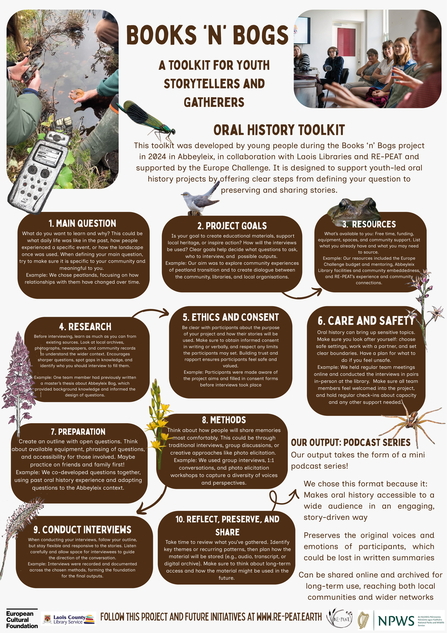
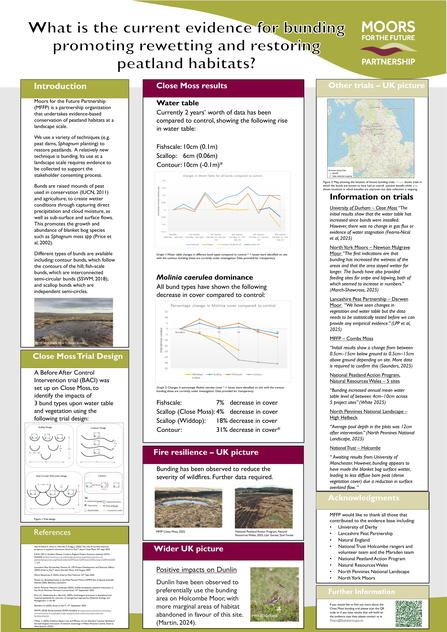
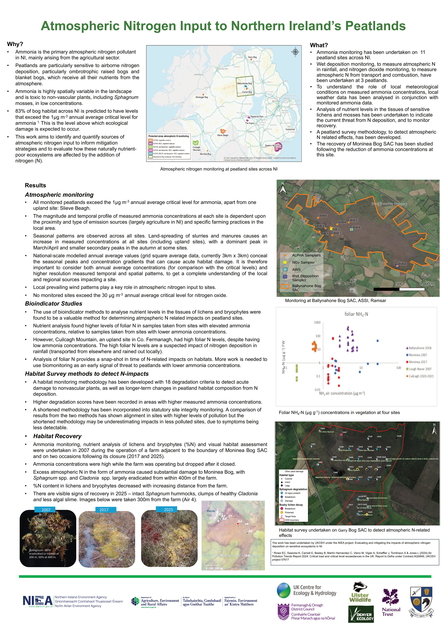
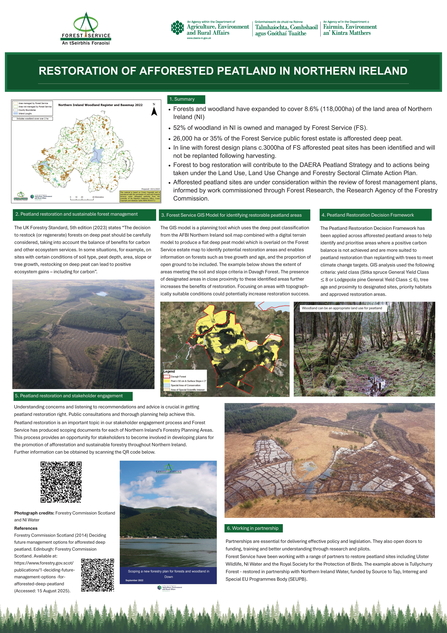
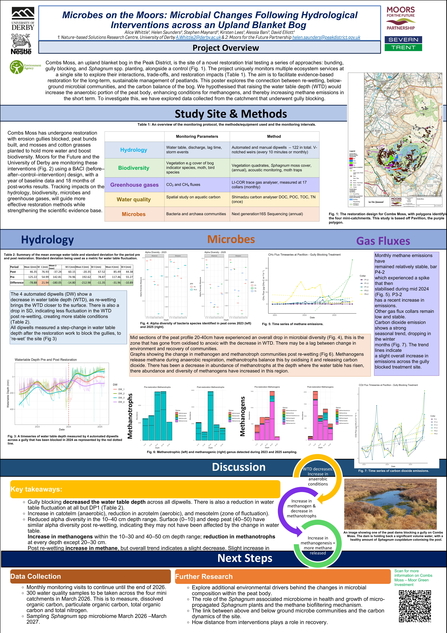
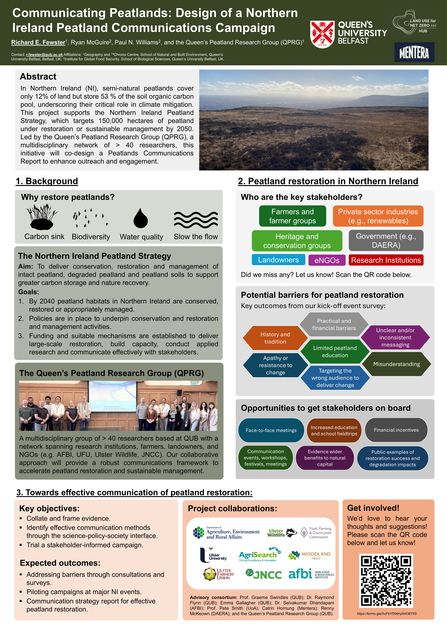
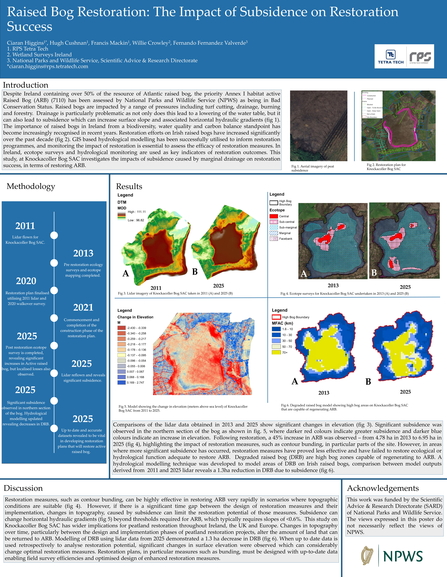
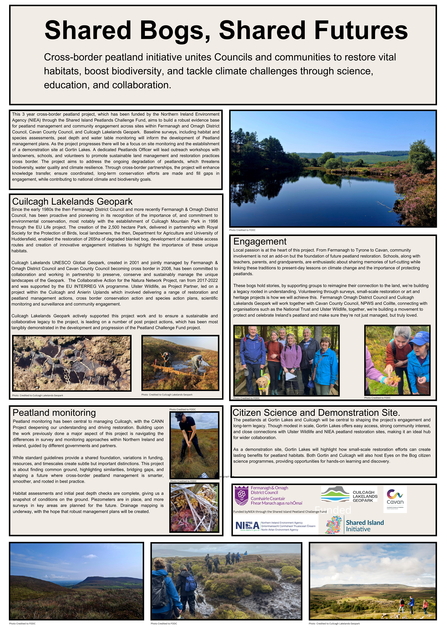
Please see a selection of posters from the conference by clicking on the images in the gallery below.
Day 2 field visits
Delegates chose from a selection of field visits across Northern Ireland and into the Republic of Ireland, exploring different peatland habitats, restoration techniques and approaches to research, monitoring and engagement.
Altikeeragh Bog
Binevenagh and Coastal Lowlands Landscape Partnership Team
Delegates joined the Binevenagh and Coastal Lowlands Landscape Partnership Team for a walk to learn about peatland restoration work on Altikeeragh Bog from source to sea. Participants had the opportunity to learn about the history of Altikeeragh Bog, early restoration attempts in the late 1990s and recent (2020 – present) work to restore the peatland and improve water quality. Monitoring of restoration outcomes is ongoing, and participants had the opportunity to discuss the restoration and monitoring methods employed. Along the way participants heard about the opportunities and challenges with other water quality and outdoor recreation projects being delivered by the Landscape Partnership. Throughout, there were breaks to take in some of the wonderful scenery and historic sites within the Binevenagh Area of Outstanding Natural Beauty.
Altikeeragh Bog is a 180.48ha area of intact blanket bog located in the uplands of Binevenagh AONB, approximately 25 miles from the city of Derry~Londonderry. Owned and managed by Northern Ireland Environment Agency, Altikeeragh Bog Nature Reserve was designated as an Area of Special Scientific Interest (ASSI) in 1999 for notable species such as the hummock-forming Sphagnum imbricatum moss. The site provides habitats for a range of upland birds including snipe, red grouse, and waders as well as many butterflies and Sphagnum mosses. Previously impacted by peat cutting and drainage, it is hoped that conservation and enhancement of this habitat will result in birds such as the hen harrier returning to breed at this site. Cuckoo, meadow pipit, sedge warbler, stonechat, male hen harrier, and grouse have all been spotted at Altikeeragh.
Peatland restoration works over the past 3 years have involved the creation of 155 peat dams and 90 plastic dams at 10m spacing and bunding to control water flow at an eroded area at the entrance to the site. The environmental benefits and outcomes of this project will be monitored in the long-term by Raymond Flynn and his colleagues in the Hydrology Department at Queen’s University Belfast using digital piezometers and dipwells located across the site. In advance of the peatland restoration works, QUB had collected a full year’s data to observe water levels and flows within the bog. This data will be used to compare water levels and flows following the dam creation works and will indicate how successful the work has been in retaining water within the bog, particularly in the drier summer months. Visual inspections of water levels and flows by the Landscape Partnership Scheme team and others within just a few months of the restoration works suggested that the dams installed as part of this project are performing well.

Altikeeragh Bog monitoring. Credit Laura McAuley.
Beaghmore Stone Circles, Haugheys Bog and Black Bog
Department for Communities Historic Environment Division and Ulster Wildlife
Delegates joined the Department for Communities and Ulster Wildlife to discover Northern Ireland’s peatland archaeology and two contrasting raised bogs.
Prehistorian Dr Vicky Ginn (DfC Historic Environment Division) led a tour around Beaghmore Stone Circles which was discovered during peat cutting in the 1940s. The site consists of seven stone circles, eight stone alignments and 12 cairns dating to the Bronze Age and is pre-dated by Neolithic occupation and cultivation. Blanket peat formation started around 400 BC in the locality, and at approximately 80 BC the peat had encroached upon the stone circles eventually covering them entirely. Some of the stone rows align with the mid-winter solstice, while the site also mirrors craters and river channels observable in the moon. The precise function of the site is open to interpretation; however, the site aptly demonstrates the exciting types of archaeology that can be found within Northern Ireland’s peatlands.
Haugheys Bog is a 30ha lowland raised bog that was industrially extracted until approximately 2017. The site was left completely bare and drained, and with forestry surrounding the site, it has been gradually colonised by Sitka spruce. In 2022 Ulster Wildlife and An Creagán purchased the site using DAERA funding, with the aim of developing it as a demonstration and training hub for practitioners, contractors and landowners. Ulster Wildlife would welcome the thoughts and experience of conference delegates to help guide the vision for this site going forward.
Black Bog SAC is one of the best examples of lowland raised bog in Northern Ireland, in the heart of the south Sperrins. Black Bog sits at the head of the Owenreagh River which is one of the last strongholds for the freshwater pearl mussel. Ulster Wildlife have been working with Forest Service Northern Ireland and private landowners to restore degraded habitats using peat dams and bunding around the edge of the site as well as removing invasive species from the open bog since 2023.

Beaghmore Stone Circles. © Crown DfC Historic Environment Division
Bencroy blanket bog
National Parks and Wildlife Service and WaterLANDS
Bencroy is a blanket bog located in the Cuilcagh-Anierin Uplands Special Area of Conservation in the Republic of Ireland. This blanket bog is facing several problems such as extensive erosion, natural/artificial drainage and invasive species colonisation coming from nearby forestry plantations. Under WaterLANDS, a Horizon 2020 project under the Green Deal, NPWS are aiming to restore over 100 ha of blanket bog using a range of techniques such as geotextiles and coir logs to reduce carbon loss and increase vegetation cover, and leaky timber and stone dams, to reduce the water flow across the site. In addition to the restoration actions, the team also has developed an extensive monitoring programme across the SAC, with several actions at Bencroy to measure the efficacy of the restoration actions in regard to water levels, water quality and carbon balance. During this visit delegates explored (1) the different restoration actions to address complex erosion on blanket bogs and (2) how to implement a monitoring programme to assess the efficacy of restoration actions.

Drone footage of restoration on Bencroy. Credit: Guaduneth Chico.
CAFRE Hill Farm Centre
College of Agriculture, Food and Rural Enterprise
The CAFRE (College of Agriculture, Food and Rural Enterprise) Hill Farm Centre is situated at Glenwherry on the southern end of the Antrim Hills and is home to 1000 breeding ewes and 100 suckler cows along with a vast range of birds and wildlife. The CAFRE Hill Farm Centre consists of 960 hectares, is the only publicly owned hill farm on the island of Ireland and has been in ownership of the Department of Agriculture, Environment and Rural Affairs (DAERA) since 1963.
In 2009, the Glenwherry Hill Regeneration Partnership (GHRP) was established to focus on improving the habitats to encourage birds and wildlife to nest, rest or forage on the hill farm whilst maintaining a productive upland livestock enterprise. Since the establishment of GHRP, CAFRE have undertaken a range of projects to help improve the habitat quality and quantity to encourage birds and other species to nest, rest or forage there, to improve water quality for a nearby water treatment plant, to provide flood resilience, to increase carbon storage and sequestration and prevent wildfires.
The site visit included seeing the recently restored Forest to Bog site and the Water Table Depth project. In addition the visit included an update on the research projects that are being carried out on the farm and the breeding wader site which is being managed with grazing livestock to encourage the nesting of breeding waders.
The visit was led by CAFRE’s Senior Biodiversity Technologist Nicola Warden and Senior Livestock Technologist Eileen McCloskey. Along the tour, the group heard from Professor Phil Jordan from Ulster University about the research work that is ongoing across the peatland areas.

CAFRE Hill Farm. Credit: Nicola Warden
Divis and Black Mountain
National Trust
The National Trust Divis and the Black Mountain property is located within the Belfast Hills, and overlooks the city of Belfast. Divis Mountain rises to 478m above mean sea level and is the highest peak within the Belfast Hills. The site is approximately 793ha, and comprises a mosaic of upland habitats, namely: Upland Heath, Purple Moor Grass and Rush Pasture, Blanket Bog, and Acid Grasslands. The site hosts the headwaters of four rivers; three flow towards Belfast and drain into Belfast Lough (showcasing Source to Sea). Alongside managing for nature, National Trust provide access, making this an important public amenity site on the edge of Belfast.
Blanket Bog (~130ha) has been heavily impacted by artificial drainage and overgrazing in the past. Since 2021, RPS and Queens University Belfast have been undertaking hydrological research onsite, this has included groundwater (piezometers installed in clusters across the peatlands onsite), runoff (assessed through flumes installed across the site), and water quality monitoring which has been linked with weather data collected onsite. Additional monitoring has included a condition assessment of the habitats onsite, and the installation of Eyes on the Bog; peatland monitoring onsite aligns with the National Trust’s Peatland Monitoring Approach.
The monitoring undertaken onsite informs the current peatland restoration plan. The first phase of peatland restoration began in September 2025. Restoration in phase 1, will target gentle slopes (<10.5%) and include peat and timber dams, and zipper infilling, along approximately 25km of drains which have been identified during monitoring. Phase 2 of restoration will be informed by ongoing monitoring throughout phase 1, but is anticipated to target remaining drains onsite, and those areas with a slope >10.5%.
To facilitate restoration onsite and to address the issue of overgrazing, the stocking rate has been reduced. The grazing livestock will now be wearing virtual fencing collars; NoFence collars. The use of NoFence collars onsite allows for target grazing of habitats, and the exclusion of grazing from blanket bog undergoing restoration, and other areas of peat which may be impacted by poaching.
Baseline Hydrological and Ecological monitoring has informed contemporary management of the habitats, particularly the peatland habitats on Divis and the Black Mountain. We anticipate that restoration work will raise the water table, increase carbon storage of the peatlands and increase the biodiversity and quality of habitats. We will continue to monitor alongside restoration, to track progress.
The field visit to Divis & Black Mountain provided an opportunity to understand how monitoring has informed our habitat restoration programme. There were contractors on site blocking drains, so delegates got to see active peat restoration works. They discovered the challenges and opportunities of upland site management and how we aim to manage for people, nature, water and carbon.

Flume installation on Divis Mountain. Credit: Andrew Corkhill.
Garron Plateau
IUCN UK Peatland Programme and Northern Ireland Environment Agency
This fieldtrip visited the Garron plateau, an area with a diverse mosaic of peatland habitat and home to a number of nationally rare species including bog orchid and marsh saxifrage. The purpose of this trip was to consider the peatland mosaic and the importance of boundary and transition habitats to the broad habitat function and health. It supported practitioners looking at how to include the wider mosaic into their work and those interested in broadening their understanding of peatland ecology.

Garron Plateau. Credit: Bobbie Hamill.
Glenveagh National Park
National Parks and Wildlife Service (NPWS)
Delegates enjoyed an 8km walk through Glenveagh National Park with the National Parks and Wildlife Service staff. The field visit started on the watershed at the head of Glen Veagh where heavily eroded blanket bog opened the conversation on the historic legacy of peat-based landscapes. There was also an introduction to on-site research linking erosion in peat-based plateau environments and grazing activity. This led into discussions regarding upland blanket bog restoration options, specifically addressing peat hags and drainage networks on steep slopes. Mitigation of downstream effects on species such as Salmon and Fresh Water Pearl Mussel is also a consideration at this site. Moving down into the valley proper, the park’s ongoing efforts to reforest 1000ha of native woodland on the valley sides were demonstrated. Deer management methods on blanket bog and associated habitats were discussed, as well as the topic of climate change and woodland expansion into Annex I peat-based habitats within Natura 2000 sites.
The field trip also passed a raised bog at the head of the Lough where discussions focused on basic restoration options for degraded cutover areas. The final leg of the walk was through ancient oak woodland where deer management and invasive species control were the subject matter.

Glenveagh National Park. Credit: National Parks and Wildlife Service
Lough Bradan
Northern Ireland Water ‘forest to bog’ restoration
Lough Bradan catchment is located 19km west of Omagh. The Lough Bradan direct catchment (355 Ha) is entirely owned by NI Water, and the Lough acts as an impounding reservoir providing 7.2Ml/day of drinking water for nearby towns and villages via our water treatment works. The area is leased by NI Water to Forest Service under a 150-year agreement (67 years in) and is currently covered mainly with coniferous forestry planted on degraded peat bog.
In 2021 NI Water restored 27 Ha of previously forested land directly around the reservoir using cell bunding and drain blocking. In 2023 we began planning additional restoration works in some recently felled compartments beside the lough. The design included a variety of techniques including contoured cell bunding, drain blocking and remedial works in the 2021 restoration area. A restoration plan was designed by Dr Hugh Cushnan of RPS and in October 2024 we appointed William O’Kane’s as our engineering contractor. Restoration work began in December 2024 and finished in February 2025.
Delegates joined a guided walk to the different areas of restoration and discussed the results of on-site hydrological monitoring.

Aerial view of Lough Bradan restoration area. Credit: NI Water.
Seamus Heaney HomePlace, Open Ground tour and Sluggan Bog
This visit celebrated the life and works of Nobel laureate Seamus Heaney, an Irish poet, playwright and translator who used his famous bog-poems to support peatland conservation and explore the relationships between people, place and identity. HomePlace is at the heart of the area that inspired so much of the poet’s work, situated between Heaney’s two childhood homes at Mossbawn and The Wood, and only a few hundred yards from St Mary’s Church, Bellaghy, which he chose as his final resting place.
Delegates joined Education Officer Angeline Kelly for a creative writing workshop exploring bog bodies and how our past and present interact, an important theme in Heaney’s writing. They also visited the Strand at Lough Beg and the Lough Neagh eel fishery, both of which feature in Heaney’s poetry.
The day also included a visit to Sluggan moss, an active peat extraction site since the 1980s. In 2012, the landowner gave permission for Bulrush Horticulture to restore part of the site, with restoration work starting that year. Over a number of years, the area was reprofiled and a series of cascading microbunds constructed to control water levels. These rewetted bunded areas were then seeded with various Sphagnum mosses and bog cotton. The top of the bunds were seeded with a mixture of heathers and purple moor grass. Water levels and species colonisation were monitored and corrective action or further seeding carried out as needed. Queen’s University PhD student Juliet Everson is preparing her thesis comparing the restored site with other designated areas of peatland in the North of Ireland.

Sluggan Bog. Credit: Bulrush Horticulture.
Springwell Farm
RSPB
Within the Antrim Hills lies 100 hectares of Blanket Bog and other associated habitats which form part of Springwell Farm. This privately owned area, partly within the Garron Plateau SAC, represents a broad range of challenges and opportunities for restoration, which RSPB have been working on in partnership with the owner for the last couple of years. It is adjacent to RSPB NI’s long term partnership with NI Water at Garron Plateau.
This site has seen damage historically from drainage, erosion, fire, and peat extraction by hand and by machine. There is also a Molinia issue here, as well as a small plantation of former Christmas trees. The site is currently grazed according to prescriptions in DAERA’s Environmental Farming Scheme (EFS), and it is within RSPB NI’s Group Option for that scheme within the Garron Plateau area.
RSPB NI has secured grant funding from DAERA through NIEA and the Shared Island Initiative’s Peatland Challenge Fund to kickstart the restoration of this site. Longer term, it is aligned and registered with the Peatland Code, and conversations on this site visit with RSPB NI and the landowner included discussion around recognition of the multiple benefits of sites like this and the support networks which may be needed to enable these sites to thrive in the years ahead.

Springwell Farm RSPB. Credit: Lauren O'Donnell.
Tattinafree Bog
RSPB
Tattinafree Bog is one of over ten raised bogs nestled within the 1,000-hectare Colebrooke Estate in County Fermanagh. Set in a landscape of inter-drumlin hollows, the estate is a rich mosaic of lowland raised bogs, farmland, and woodland. The RSPB is currently developing a comprehensive restoration plan for all ten bogs as part of a Peatland Code project cluster.
Historically, Tattinafree, like the other bogs on the estate, has suffered from drainage and turf cutting, both by hand and machine. These past interventions have led to habitat degradation and significant greenhouse gas emissions. The restoration project aims to reverse this damage through techniques such as drain blocking, reprofiling eroded peat surfaces, and rewetting degraded areas.
Delegates joined a guided visit where the RSPB shared their restoration approach and delved into the unique challenges Irish raised bogs face. They had the chance to see areas once used for hand-cut turf to heat local homes, machine cut areas, and some areas where peat has been excavated down to the mineral layer. Some sections have naturally filled with water, forming stunning shallow pools, while others have been overtaken by trees or afforested with conifers. The bog’s edge is tightly bounded by intensive agriculture, a common scenario in Ireland, which adds complexity to restoration efforts, particularly where drain-blocking is needed.
Despite these pressures, Tattinafree remains a striking example of a raised bog ecosystem. In places, over 10 metres of peat still persist, supporting vibrant Sphagnum mosses, Greater Sundew, Large Heath butterflies, Green Hairstreaks, and a kaleidoscope of dragonflies and damselflies. This site visit offered the opportunity to witness the resilience of peatland habitats and see how targeted restoration can bring them back to life.

Tattinafree Bog. Credit: Maria Mulholland.
Topic deep dives
The third day of our conference saw a series of knowledge exchange sessions and workshops and the discussion of issues facing peatland restoration.
Mapping and monitoring technologies
Accurate information on the distribution and condition of peatlands is vital for informing effective restoration and conservation policy. Advances in hydrological monitoring, remote sensing, and data modelling are transforming the way we collect, analyse, and apply this knowledge. From AI-driven approaches to innovative sensor technologies, these tools promise greater efficiency, larger datasets, and deeper insights compared to traditional field methods — but they also bring new challenges and risks. In this knowledge sharing session, experts from Natural England’s England Peat Map project and leading technology providers including In-Situ, Plant-e and Gentian present current innovations in peatland monitoring and mapping. We explore the opportunities and limitations of these approaches and discuss how they can complement established monitoring techniques to inform future peatland policy and practice.
Why understanding ecohydrology is important
This Environment Agency–led topic deep dive explores why understanding ecohydrology is fundamental to successful peatland restoration. Through a series of presentations and UK-wide case studies, speakers highlight how the underlying water environment—from base flow and sediment runoff to water quality—shapes effective restoration planning and implementation. The session connects scientific insights with practical outcomes, showing how hydrology underpins restoration targets, influences SSSI condition, and informs decisions in areas facing development pressures. Bringing together multidisciplinary perspectives, the session builds confidence in applying ecohydrological guidelines and reinforces the vital role of water in achieving healthy, functioning peatlands. This playlist showcases shared learning from across the UK and demonstrates why ecohydrology must sit at the heart of informed restoration and land management strategies.
Mosaic habitats
Following up on the themes of the field trip to Garron Plateau on Day 2 of the conference, this knowledge sharing session showcased talks to ‘deep-dive’ the issue of small boundary habitats and their importance to the peatland mosaic. The session considered the threats to these systems and investigated how we might include these habitats in both restoration and land use planning. The recording will be of interest to those looking to deepen their knowledge of peatland mosaics and habitats and the interconnectedness of the landscape.
Jess Fíor-Berry Mosaic Habitats (https://youtu.be/8igd5nGtGKg)
The IUCN UK Peatland Programme's Policy Lead and passionate botanist Jess Fíor-Berry introduces our session on mosaic habitats at our 2025 annual conference.
Richard Lindsay Why Fens and Flushes are Important (https://youtu.be/nAQWwN4iHD8)
Peatland expert Richard Lindsay explains the importance of often-overlooked yet widespread fens and flushes at our 2025 annual conference session on mosaic habitats.
Iain Diack, Principal Specialist - Wetlands at Natural England, discusses the importance of peatland mosaics at our 2025 annual conference.
Shirley Clerkin Focus on Fens - Treasures of the Midlands (https://youtu.be/4or6iP9yHkU)
Shirley Clerkin, Project Manager at Tóchar Wetlands, discusses fen restoration in the Irish Midlands at our 2025 annual conference session on Mosaic Habitats.
Edward Adam Peatland Mosaics in the South West of England (https://youtu.be/Tx5w9TYvhIM)
Edward Adam, Monitoring Manager at South West Peatland Partnership discusses restoration works at Pit Park in Cornwall during our 2025 conference session on Mosaic Habitats.
Mosaic Habitats Q&A (https://youtu.be/Sua4GO2A3Ks)
The Q&A from our 2025 annual conference session on Mosaic Habitats.
Risks and rewards with wool as restoration material
This workshop aimed to share knowledge, case studies and ways of working to highlight the environmental risks and potential associated with the various wool products on the market. The session:
- Showcased what is being done to clarify and understand these risks.
- Demonstrated various ways that wool could be used and discussed whether it is a viable material in different formats, for peatland restoration.
- Discussed policy approaches and various blockers to wool being widely implemented.
The workshop featured a series of presentations followed by a group discussion from practitioners and policy makers on what evidence gaps need filling, who can help who, and what can be done at a policy level to enable wool to reach the potential it has.
Beth Thomas Wool on Yorkshire's Uplands (https://youtu.be/nYWeHvQnWvs)
Beth Thomas, Data and Evidence Manager at Yorkshire Peat Partnership, explains how they are using sheep wool in peatland restoration as part of the topic deep dive on this theme at our 2025 annual conference.
Hugh McLindon, District Conservation Officer at NPWS Wicklow and Lorna Kelly, Coordinator at Wicklow Uplands Council, discuss the use of sheep wool in peatland restoration as part of our topic deep-dive on the subject during our 2025 conference.
Sinéad Grimes, Project Manager Dúlra Project at FORUM Connemara CLG and Roisin Donnelly, Ecological Consultant, discuss the use of wool in peatland restoration as part of our topic deep-dive on the subject at our 2025 conference.
Jonathan Robinson-Noades explains how South West Peatland Partnership has been trialling the use of sheep wool in peatland restoration at our 2025 conference topic deep-dive on the subject.
Fabio Messori explains his PhD research at the University of Cumbria in our 2025 conference session on Risks and Rewards with Wool as a Restoration Material.
Learning from our mistakes: a practitioner's guide to resilient peatland restoration
Peatland restoration is rarely a straight path, and mistakes can be as instructive as successes. This interactive, practitioner-focused workshop invited participants to explore the challenges, setbacks, and unexpected outcomes encountered in peatland restoration projects across the UK.
The workshop explored case studies where things didn’t go to plan—examining what went wrong, why it happened, and how these hurdles were overcome. This was followed by open group discussions, where we shared our experiences and uncovered the hidden value of failure as a driver of innovation and resilience in restoration practice.
Getting into the bog: creative skills to support your practice
Creative expression is a uniquely powerful form of expression and engagement, and there are numerous practitioners and projects working with peat. However, there’s limited evidence that ecologists, academics, conservation officers, project managers and fund raisers working with peat are drawing on creative techniques to support and develop their work.
In this day-long workshop, delegates familiarised themselves with creative practice around peat, and considered how creative writing skills might inform their work in public engagement, evaluations, essays, marketing copy, report writing, etc.
Atmospheric pollution
This topic deep dive explored the relationship between atmospheric pollutants and peatlands. Atmospheric pollutants are highly diverse and complex: they can be particulate or chemical in nature and they may be relatively localised or carried some distance in the atmosphere before deposition occurs during rainfall events. Peatlands are particularly vulnerable to atmospheric pollution, as they receive high levels of precipitation and occult precipitation. This session featured talks exploring the sources of atmospheric pollutants, their diverse impacts on peatlands, restoration techniques and challenges in areas impacted by atmospheric pollution, and policy options.
Richard Fewster from the University of Manchester explains his research on the distribution and impacts of atmospheric pollution on global peatlands at our 2025 annual conference.
Áine O’Reilly from Northern Ireland's Environment Agency presents the results of research on atmospheric nitrogen deposition at our 2025 annual conference.
Matthew Scott-Campbell from Moors for the Future Partnership explains the impacts of industrial pollution at our 2025 annual conference.
Kellie McEvoy and Stephanie Clokey Farming Perspectives (https://youtu.be/JO6TnS76KPY)
Kellie McEvoy and Stephanie Clokey from Ulster Farmers' Union provide perspectives on farming policy and sustainable peatland management at our 2025 annual conference.
Sustaining land, empowering people: community-centred peatland restoration
Community-based natural resource management is based on the pillars of economic development, environmental conservation and community empowerment. This session showcased examples of community-centred peatland restoration in which communities are driving positive change in their local environment through bottom-up, democratic approaches to sustainable land management. We explored the following questions:
- What are the pros and cons of community-centred restoration projects?
- Do we have many projects of this nature in Ireland/UK?
- What examples are there of organisations facilitating this approach and how do we disseminate their work more widely?
- What can we learn from global examples?
- Is there appetite for this type of project?
- What are the barriers and enablers?
- What type of support (financial or technical) is required?
Garry Luttrell Abbeyleix Bog Project (https://youtu.be/BRnQCjjTejg)
Garry Luttrell, Director of Abbeyleix Bog Project CLG shares the work of the project at our 2025 conference session on community-centred peatland restoration.
Michael Carroll Clonbeale More Peatland Conservation Project (https://youtu.be/21qek5foYVo)
Michael Carroll, Chairperson of Environment and Sustainability Committee at Tullamore Lions Club, shares the work of the Clonbeale More Peatland Conservation Project at our 2025 conference session on community-centred peatland restoration.
Gary Goggins and Colm Gavin Natura Communities (https://youtu.be/O4uCmwcp0sw)
Gary Goggins, Public Awareness Manager at NPWS / LIFE IP Wild Atlantic Nature and Colm Gavin, Farmer with the Natura Communities Initiative share their experiences of results-based payment schemes in our 2025 conference session on community-centred peatland restoration.
Zarah Finn NPWS Community Engagement Initiatives (https://youtu.be/VQ-KJLRVYUE)
Zarah Finn, Executive Officer at Ireland's National Parks and Wildlife Service, describes key foundations for community-centred peatland restoration at our 2025 conference.
Community-Centred Peatland Restoration Reflections (https://youtu.be/s_oH6Uy9guE)
Speakers at our 2025 conference session on 'Community-Centred Peatland Restoration' share their key messages for supporting community-centred projects.
Exploring recent learning for water management in lowland agricultural peat
Led by the Environment Agency, this topic deep dive explored recent learning on water management in lowland agricultural peatlands across England and Ireland. With a focus on responding to the climate and biodiversity crises, the session highlighted how integrated hydrological management underpins more sustainable land uses, including cropping, grazing, rewetting, paludiculture, and nature restoration. Presentations shared findings from research and pilot projects, such as those supported by the Environment Agency’s Lowland Agricultural Peat (LAP) schemes, and initiatives in Ireland that align with similar goals.
The session profiled strategic approaches to managing water tables, assessed risks and benefits, and explored how to create more space for nature within productive landscapes. Discussions encouraged knowledge exchange between nations, with a view to identifying collaborative opportunities and shaping a future vision for lowland peat that balances environmental integrity with land use needs. Attendees left with a deeper understanding of the evidence base and greater confidence in making informed decisions on LAP land use and water management.
Ross Morrison Impacts of Drought on UK Peatlands: From East to West (https://youtu.be/z-qmqx0SZeI)
Ross Morrison presents water balance data from the flux tower network in England and Northern Ireland at our 2025 annual conference.
Megan Ellershaw Paludiculture Exploration Fund (https://youtu.be/bRR9xDtff8M)
Megan Ellershaw from Natural England discusses the Paludiculture Exploration Fund at our 2025 annual conference.
Niall Ó Brolcháin Palus Demos (https://youtu.be/9Mu2O_Bfz4Q)
Niall Ó Brolcháin from the University of Galway introduces the Horizon Europe-funded project Palus Demos at our 2025 annual conference.
Mike Longden from the Wildlife Trust for Lancashire, Manchester and North Merseyside discusses the role of paludiculture in supporting hydrological connectivity and biodiversity at our 2025 annual conference.
Doug McMillan from the Green Restoration Ireland Cooperative Society discusses the 'Peatlands for Prosperity' project at our 2025 annual conference.
In this Q&A from our 2025 annual conference, speakers discuss the role economics and benefits of paludiculture and the importance of farmer engagement.
Day 3 panel discussions
The final day of the conference opened with a plenary sharing successes and challenges for the latest generation of peatland restoration practitioners, and concluded with a plenary session reflecting on findings from the conference with representatives from across the UK.
Generation restoration: peatlands and the future workforce
The future of our peatlands depends on the next generation of scientists, policymakers, practitioners, and land managers. Fresh perspectives, creativity, and energy are essential to accelerating restoration efforts and driving meaningful change. This plenary session spotlighted emerging talent in the peatland community, offering a platform for youth representatives to share their visions, experiences, and aspirations. The panel explored the diverse career paths available to new entrants in the sector and discussed the key barriers and enablers to achieving the scale and pace of action that peatlands urgently require.
Generation Restoration Panel Discussion (https://youtu.be/XrzrdwFdH7A)
'Generation Restoration' panel discussion from the IUCN UK Peatland Programme conference 2025.
Peatland Progress: one year on from the UK Peatland Strategy report
As we drew the conference to a close, this plenary session brought together representatives from the four UK nations to share rapid-fire insights on national progress for peatlands. Building on the UK Peatland Strategy Progress Report published in 2024, each speaker delivered a lightning talk highlighting key developments, with a particular focus on new mechanisms and approaches to meet capacity and scale restoration efforts. The panel also reflected on the key themes, challenges, and opportunities emerging from the conference, offering a forward-looking perspective on what’s needed next to deliver impact at pace and scale across the UK’s peatland landscapes.
Sara McGuckin Peatland Progress: Northern Ireland (https://youtu.be/ZGI92neoMnQ)
Sara McGuckin, Head of Natural Scienceat the Northern Ireland Environment Agency, provides an update on progress for peatlands in Northern Ireland at our 2025 annual conference.
Claire McVeigh Peatland Collaborative and Technical Network (https://youtu.be/z0u4DoyLMyE)
Claire McVeigh, Peatland Collaborative and Technical Network Officer at Ulster Wildlife, shares the work of the network at our 2025 annual conference.
Jake White Peatland Progress in Wales (https://youtu.be/EBfGAggTsjI)
Jake White, Team Leader at the Wales National Peatland Action Programme, provides an update on progress for peatlands in Wales at our 2025 annual conference.
Chris Moses Peatland Progress in England (https://youtu.be/1qq80zbprKE)
Christopher Moses, Policy Lead (Lowland Peat) at the Department for Environment, Food and Rural Affairs, provides an update on progress for peatlands in England at our 2025 annual conference.
Heather Perman Peatland Policy and Restoration in Scotland (https://youtu.be/yqyqT2Sd1-o)
Heather Perman, Programme Manager – Peatland Restoration at the Scottish Government, provides an update on progress for peatlands in Scotland at our 2025 annual conference.
Deborah Land Peatland Policy and Restoration in Scotland (https://youtu.be/9ugRJ2n5FqA)
Deborah Land, Peatland ACTION Project Manager - Delivery at NatureScot, provides an update on the work of the Peatland ACTION programme at our 2025 annual conference.
Peatland Progress Panel Discussion (https://youtu.be/EqaUxbumOkk)
A panel discussion on national progress and challenges facing peatlands with representatives from the four UK nations. Part of the IUCN UK Peatland Programme 2025 annual conference.
Closing Reflections and the Inaugural Lindsay Peatland Conservation Award
Craig Bennett, CEO of the Wildlife Trusts, reflected on our event in the wake of the Labour Party's 2025 conference, and we presented the Inaugural Lindsay Peatland Conservation Award to one of the most influential and inspiring peatland champions in the world, Richard Lindsay.
Craig Bennett Peatlands for Climate and Nature (https://youtu.be/G6aitJsQx5k)
CEO of our host organisation the Royal Society of Wildlife Trusts, reflects on the growth of the UK peatland community at our 2025 annual conference.
Inaugural Lindsay Peatland Conservation Award Presentation (https://youtu.be/jv1pA_M13Fo)
Presentation of the Inaugural Lindsay Peatland Conservation Award to Richard Lindsay at our 2025 annual conference.
Read more in our news piece about the award and Richard's work for peatlands.

Thanks to all our partners, supporters and sponsors for helping us deliver our 2025 conference - we couldn't do it without you!