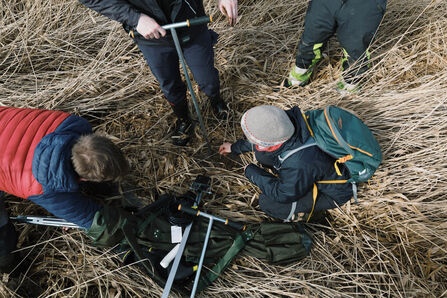
The monitoring project was delivered by Environment Policy Advisor Andrea Kelly and Sustainability Manager Harry Mach and is based on a site that was previously extensively drained for farming. With funding from Natural England’s ‘Nature for Climate Programme’ and Anglian Water’s Get River Positive Programme, staff carried out works to improve water retention on the site. During autumn winter 2025-2026 sluice gates and a bund were installed with the aim of raising summer water table levels.
Whilst remote monitoring of water levels is not new in the Broads, it has previously been a labour-intensive process or required ‘work arounds’ such as web cams pointed at gauge boards. Poor connectivity in some of the more isolated areas of the Broads means getting data onto a network has previously been quite challenging.
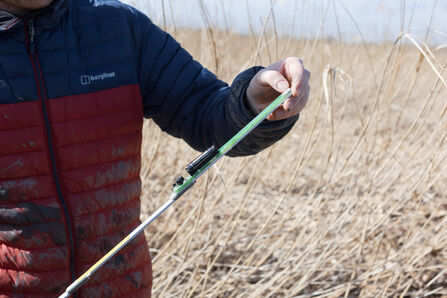
In March 2026, nine dipwell sensors were installed on the site along the River Ant. These sensors were connected to a server using new technology from Cwiri Ltd, a startup of UKCEH, specialising in environmental monitoring and carbon verification across peatland and woodland projects. The solar-powered sensors transmit the water level data to a gateway which in turn uploads the data to a server. The so-called LoWaRAN ('low-powered, wide-area network') is a cheap and effective way to conduct remote monitoring.
A spokesperson for Cwiri Ltd said: