
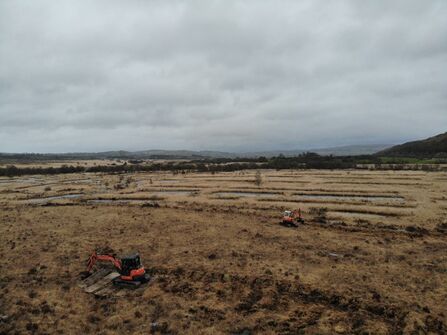
LIFEquake project site at Dowrog Common in Pembrokeshire, Wales. Credit: LIFEquake project, Natural Resources Wales.
Conference 2026: Day 2 Programme (10th June)
Swansea University Bay Campus and various field locations, Wales
Day 2 of #PeatConf26 features a full programme of field visits, our gala dinner and conference tradition: twmpath dancing
Field visits take place across South Wales, with dinner and dancing in the Great Hall at Swansea University Bay Campus.
Ticket sales have now closed.
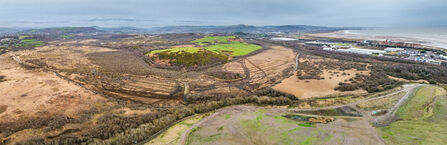
Aerial view of Crymlyn Bog with Swansea University Bay Campus in the distance. Credit: LIFEquake project, Natural Resources Wales.
LLyn LLech Owain Country Park by National Peatland Action Program
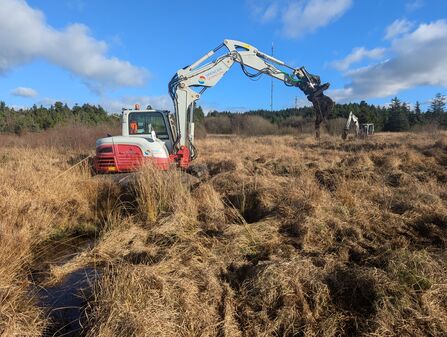
Contour bunding being installed on Cors Caron SE Bog
© Natural Resources Wales
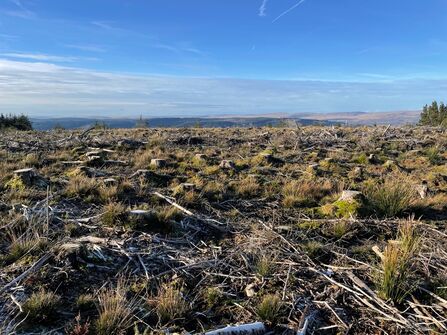
Felled conifer plantation on Rhigos Mtns – with Bannau Brycheiniog NP in background. Jonathan Walker
7.30 - 9am Day 2 delegate registration (Great Hall Foyer)
7:30 - 10am Packed lunch pick-up (Social Hideaway)
8am - 5.30pm Field visits
6pm Bar opens
7pm Gala dinner (Sir Stanley Clarke Auditorium)
9pm Allan yn Y Fan twmpath band
- View our Gala dinner menu (https://www.iucn-uk-peatlandprogramme.org/sites/default/files/2026-06/IUCN_Gala_Dinner_Menu.pdf)
- Find your table for dinner (https://view.officeapps.live.com/op/view.aspx?src=https%3A%2F%2Fwww.iucn-uk-peatlandprogramme.org%2Fsites%2Fdefault%2Ffiles%2F2026-06%2FIUCN_UK_PP_Conference_2026_Dinner_Seating%2520_Plan.xlsx&wdOrigin=BROWSELINK)
Field Visits
Lunch and transport will be provided and delegates will be required to select field trips in advance on a first come, first served basis. If you've booked a ticket, you'll receive an email with instructions on booking your visit choice.
All trips will leave from Swansea Bay Campus' restaurant the Social Hideaway on Severn Way. Please pick up your packed lunch from the Social Hideaway between 7:30am and 10am.
Field Visit A+B: Crymlyn Bog National Nature Reserve, Swansea

Crymlyn Bog National Nature Reserve, Swansea, credit LIFEquake
OPTION A - FULLY BOOKED
AM itinerary - transport with Cymru Coaches & Gower MiniTravel in 16-seater minibuses
Time Location
9:30am Depart Bay Campus
9:40am Arrive Crymlyn Bog
12:10pm Depart Crymlyn Bog
12:20pm Arrive Bay Campus
OPTION B
PM itinerary - transport with Cymru Coaches & Gower MiniTravel in 16-seater minibuses
Time Location
1:30pm Depart Bay Campus
1:40pm Arrive Crymlyn Bog
4:15pm Depart Crymlyn Bog
4:25pm Arrive Bay Campus
‘Against all odds’ - Transition Mire & Quaking Bog restoration on the edge of Wales’ second city
The mosaic of peatland landscapes that converge on Crymlyn Bog and the neighbouring Pant y Sais Nature Reserve offer a potentially unrivalled example of triumph over adversity in-keeping with this year’s conference theme of ‘Peatlands under pressure.
Situated only a few miles from the 250,000 population of Swansea, (Wales’ second city) and flanked by former landfill sites, motorways, remnants of oil, coal and copper industries and an extensive network of canals, Crymlyn is living proof that even when faced with challenges such as these, nature still finds a way!
The Crymlyn Nature Reserve, home to the rare fen raft spider is approximately 300ha in size and comprises excellent examples of fen, transition mire and quaking bog habitats. A main focus of the LIFEquake peatland restoration project delivered by Natural Resources Wales and partners, Crymlyn truly is a diamond in the rough!
Visit synopsis
The Crymlyn Visitor Centre is the perfect start and end to a 1.4km circular walk which takes visitors through the many different historic landscapes which also include the “Balloon Field” – a CADW designated site where Second World War barrage balloons were flown in an attempt to safeguard the Llandarcy Oil Refinery which once stood at the Eastern edge of Crymlyn Bog.
This site visit, delivered by LIFEquake Project Manager Gareth Thomas; Crymlyn Reserve Manager Jamie Bevan, and leading peatland hydrologist Dr Rob Low, will offer a detailed understanding of the many challenges affecting the peatland at Crymlyn, the rich and varied history that has shaped and threatened its existence and the many different interventions that are being delivered to secure its future. Members of the Natur Am Byth / Buglife team will also deliver a talk on their work monitoring populations of the fen raft spider found onsite – the only habitat in Wales where this rare species can be found.
Management of invasive species, mowing, canal clearance and brook remediation will all feature in this half-day tour, as will a chance to observe the wealth of peatland vegetation and invertebrates which will be thriving in these early summer moments.
Accessiblity information
The guided walk is 1.4km of mostly level woodland and wooden board-walk so is accessible to most but may still be a little uneven and muddy in places. Wheelchair access is not available. The well-resourced visitor centre provides toilets and shelter from the elements in the event of bad weather.
This field visit will be offered twice; once in the morning and once in the afternoon. Each half-day visit will take 2.5hrs with 10min of travel either way.
This visit is not wheelchair accessible.
Field Visit C+D: Llyn Llech Owain Country Park (SSSI) - Wheelchair accessible

LLyn LLech Owain Country Park by National Peatland Action Program
OPTION C - FULLY BOOKED
AM itinerary - transport with South Wales Transport minibus
Time Location
9:00am Depart Bay Campus
9:30am Arrive Llyn Llech Owain Country Park
12:00pm Depart Llyn Llech Owain Country Park
12:30pm Arrive Bay Campus
OPTION D
PM itinerary - transport with South Wales Transport minibus
Time Location
1:00pm Depart Bay Campus
1:30pm Arrive Llyn Llech Owain Country Park
4:00pm Depart Llyn Llech Owain Country Park
4:30pm Arrive Bay Campus
Management of a County Country Park
Llyn Llech Owain country park is an area of 73 hectares which is owned and managed by Carmarthenshire County Council (CCC) for nature and outdoor recreation. The name, translated as ‘lake of Owain’s slate slab’, references the legend that Owain forgot to replace the slab over a well, resulting in the creation of a lake.
In 1993 the lake was designated as a Site of Special Scientific Interest for being a shallow, highly acidic waterbody which is uncommon at low altitudes for the area. A section of the site is additionally a Special Area of Conservation for wet and dry heathland habitat.
Surrounding the waterbody is a raised bog with some peat depths exceeding eight meters. The National Peatland Action programme has been working with CCC to design a phased approach to improving the hydrological integrity of the peatland. Phase 1 of restoration has already been complete via the creation of 807m of low elevation contour bunds and planning is underway for the next phased approach.
The site visit, led by NPAP, will address considerations of peatland restoration within a County Country park, designated land and pressures to restock conifer plantations on peatland habitat.
Accessibility information
The route of approx. 1.8km will consist entirely of maintained paths and boardwalk, so sturdy walking shoes/boots are recommended. Toilets with disabled facilities are available as well as a café for refreshments. The classroom and site walk is wheelchair accessible.
This field visit will be offered twice; once in the morning and once in the afternoon. Each half-day visit will take 2.5hrs with 30min of travel either way.
This visit is wheelchair accessible.
Field Visit E: Dr Beynon's Bug Farm and Dowrog Common, St Davies, Pembrokeshire

Aerial view of Dr Beynon's Bug Farm by Andy Holcroft
Itinerary - transport with South Wales Transport coach
Time Location
8:00am Depart Bay Campus
10:00am Arrive Dr. Beynon’s Bug Farm
10:00am Opportunity to buy drinks from café
10:30am Welcome and introduction
10:45am Tour of the Bug Farm group 1/Tour of Dowrog Common Group 2
12:30pm Lunch
1:00pm Tour of the Bug Farm group 2/Tour of Dowrog Common Group 1
2:30pm Final Questions and Gift shop will be open
2:45pm Depart Dr. Beynon’s Bug Farm
4:40pm Arrive Bay Campus
Marsh Fritillary Reintroduction and Managing ‘Fen Mosaic’ Lowland Heath Habitat
This visit features two nearby sites situated centrally on the beautiful St Davids peninsula: Dr Beynon’s Bug Farm and Dowrog Common, which forms part of the North West Pembrokeshire Commons SAC, a nature corridor that runs from St Davids Airfield Heaths SSSI out to the wild north Pembrokeshire coast.
The Bug Farm
The Bug Farm is a cutting-edge, award-winning Welsh nature recovery project and the brainchild of visionary ecologist, farmer and entomologist Dr Sarah Beynon. Three separate farms come together to create a dynamic 65-hectare habitat corridor, nature reserve, research centre and visitor attraction.
With a mixture of active nature recovery and an element of rewilding, over the past 13 years, the intensively farmed mixed beef and arable farm has transformed into a thriving nature reserve and its marshy grasslands are due to be designated as a SSSI in 2026/2027. Large-scale nature recovery projects include heath creation, meadow creation, arable habitat creation, marshy grassland management, woodland creation and freshwater habitat creation.
The Bug Farm has led a project over the past 6 years that has focussed on bringing back the locally-extinct marsh fritillary butterfly to the St Davids peninsula. This will be the first marsh fritillary reintroduction in Wales and the butterflies will be in captivity in rearing pens at The Bug Farm during the visit.
Dowrog Common
Dowrog, found between Waun Fawr and Tretio Common, has received LIFEquake peatland restoration project interventions over the last two years.
At 101 hectares, Dowrog boasts variety of habitat perhaps best described as ‘Fen Mosaic’ Lowland Heath. This historic landscape transitions through a wide variety of vegetation communities from dry heath to swamp.
Dowrog’s fascinating history ranges from forming part of the ‘Pilgrims Trail’ to St Davids; the enclosure of the Commons Act and a ‘Ty Unnos’ house built in the middle; to a more industrial past with a ‘mill leat’ dug across the common supplying water to the old corn mill nearby.
Dowrog Pool, formerly open water, sits in the depression on the North Western end of the site, which as grazing pressures have decreased over the years has vegetated over by dominant greater tussock sedge. Over the last 2 years, works have been carried out to remove sedge to create more open water and promote the expansion of the last remaining areas of transition mire.
LIFEquake actions around mowing, transition mire scrapes and grazing with multiple cattle herds on a common will all feature in this site visit. Delegates will gain a good understanding of the area’s complex hydrology, Dowrog’s backstory and how its future is being safeguarded.
Visit synopsis
The visit will begin and end at The Bug Farm. In a bespoke visit, led by Dr Sarah Beynon, you will explore the farm's new Nature Recovery Centre - an educational centre about our relationship with food, farming and nature in the past, present and future. Sarah will guide you on a farm walk through the marshy grassland, Devil’s-bit scabious plug planting and heath habitat creation sites and to St Davids Airfield Heaths, a SSSI site that is part of the SAC and grazed by The Bug Farm's cattle. You will see Monil virtual fence collars in action on the cattle (and see examples of NoFence collars) and wander back through the new woodlands, arable fields and meadows.
A walking tour of Dowrog Common will be delivered by LIFEquake project partners Chris Lawrence of NRW’s Pembrokeshire Environment Team, Nathan Walton, Reserves Manager Wildlife Trust West Wales, and Laura King, Peatland Hydrologist at Rigare. Keep an eye out for small red damselfly, lesser butterfly orchid, wavy st john’s-wort as well as bog bean, cotton grass and marsh cinquefoil in abundance.
Accessibility information
Walking distance will be 3-4km on terrain that can be wet, boggy and uneven in places. There are uneven stepping stones across a river and some tussocky areas which require a little more concentration. The walk will include meadows, wetland and arable habitats. Wellies/waterproof boots are essential. Appropriate outdoor weather gear, whether waterproofs or sun hats (or more likely for Pembrokeshire - both!) will be required.
There are toilets on site and the farm's award-winning Grub Kitchen cafe will be open for drinks, cakes and snacks - you can also try their Cricket Cookies, as they are the UK's first edible insect cafe (with lots of non-insect options available too).
This field visit takes approx. 4hrs on site and 2hrs each way of travel.
This field visit is not wheelchair accessible.
Field Visit F: Bannau Brycheiniog National Park (Brecon Beacons) - FULLY BOOKED

Brecon Beacon splash to repair credit Waun Wen from Bannau Brycheiniog National Park
Itinerary - transport with South Wales Transport coach
Time Location
8:30am Depart Bay Campus
9:30am Arrive National Park at Neuadd car park near Taf Fechan
09.45am Depart on site guided walk
10.00am Exploring peat conditions and discussions
12.30pm Lunch
1:00pm Heading SE. Reach end of site visit near Ponsticill Reservoir
2:30pm Depart National Park
3:30pm Arrive Bay Campus
Restoring Dry Modified Upland Blanket Bogs in Bannau Brycheiniog
(Brecon Beacons National Park)
Join us for a full‑day field visit to the spectacular uplands of Bannau Brycheiniog National Park, where we will explore the challenges and opportunities associated with restoring dry modified blanket bog on the southern margins of the National Park.
This collaborative visit brings together expertise from Bannau Brycheiniog National Park Authority, the National Trust, and Dŵr Cymru/Welsh Water, offering a unique opportunity to see current restoration work first-hand and discuss emerging approaches with practitioners working across the landscape.
Visit synopsis
Participants will visit active restoration sites and take part in guided discussions on:
• Restoration techniques for degraded, dry modified blanket bog.
• Anticipated changes in intervention methods in response to evolving evidence and conditions.
• Place within wider upland systems, including commons management and grazier involvement.
• Key pressures such as wildfire risk, illegal off‑roading, erosion, and visitor impacts.
• Drivers for restoration: nature recovery, carbon conservation, and catchment/water management.
• Collaborative working at landscape scale, comparing operations, approaches, and lessons learned.
• Integration with other land management initiatives, including Ffemio Bro.
• Natural capital considerations—opportunities, challenges, and the scoping of scheme viability within the National Park.
• Knowledge gaps and research needs, including how climate and land‑use change influence bog function, resilience, and restoration outcomes.
Accessibility information
This is a 10 km strenuous hill walk with an initial 240 m steep ascent. Terrain is rough and uneven in places, though we will follow mountain paths wherever possible. After the main climb, the route descends steadily towards the finish point. Walking boots, warm layers and full waterproofs are essential.
This field visit will take approx. 4.5hrs with 1hr of travel each way.
This site visit is not wheelchair accessible. There are no facilities at the start or finish locations. However, minibuses will pass through Pontsticill, where public toilets are available.
Field Visit G: Mynyddoedd Rhigos Mountains - FULLY BOOKED

Felled conifer plantation on Rhigos Mtns – with Bannau Brycheiniog NP in background. Jonathan Walker
Itinerary - transport with South Wales Transport coach
Time Location
9:10am Depart Bay Campus
9:55am Arrive Pen y Cymoedd Wind Farm
10am to 12pm Site Visit 1
12am to 12:15pm Lunch at Educational Hub
12:15pm to 3:00pm Site Visit 2
3:00pm Depart Pen y Cymoedd Wind Farm
3:45pm Arrive Bay Campus
Forest-to-bog Restoration
The Rhigos Mountains are the most southerly mountain range in Wales. They represent the watershed catchments of the famous South Wales valleys within which was located the heavy industry (mining and steel) that dominated the region for so long and many of the major cities and towns of South Wales.
Peatlands are extensive across the Rhigos Mtns, however, in a UK context they are climatically relatively marginal and high(er) risk from climate change. Post-war, a significant area of the mountains and peatlands were planted with conifers and a 76-turbine wind farm constructed ~10 years ago. The conifer plantations have reached maturity and are being felled and the underlying peat systems are being restored to a land cover ‘lost’ for several decades.
Visit synopsis
Delivered by Swansea University, Natural Resources Wales, the Lost Peatlands Project and Vattenfall (Pen y Cymoedd Wind Farm), this visit is a ~4.5 km (2.8 mile) walk along forestry roads and trails, down the spine of the Rhigos Mountains, along which you’ll learn and experience the story of the mountains and the challenges and success of the extensive forest-to-bog peatland restoration works taking place there; including:
- The unique geographical and environmental context of the Rhigos Mtns: considerations and constraints
- Impacts of conifer afforestation on peatland systems
- Post-forestry recovery targets
- The Pen y Cymoedd Wind Farm
- Afforested bog restoration: approaches trialled, approaches delivered at scale (the innovation of restoration techniques suitable for these mountains)
- Grazing forest to bog restoration sites
- Conifer (and other tree species) regeneration and control
- Peatland system recovery – the impacts of the restoration (monitoring and research findings)
Accessibility information
This visit entails an easy 4.5 km walking trip along forestry roads and trails (a brand-new national trail) with a few gentle hills along the way. Sturdy footwear is required. If the weather is hot and dry, it could be very dusty.
This field visit will take approx. 5hrs with just under 1hr of travel each way. We anticipate toilet facilities at two locations along the route (TBC).
This site visit is not wheelchair accessible.
Field Visit H: Figyn Blaen Brefi, Ceredigion - FULLY BOOKED

Figyn Blaen Brefi - Bog at the head of the River Brefi, credit National Peatland Action Program
Itinerary - transport with Cymru Coaches minibuses
Time Location
8:15am Depart Bay Campus
9:45am Toilet stop at Tregaron
10:30am Arrive Figyn Blaen Brefi
2:15pm Depart Figyn Blaen Brefi
2:30pm Toilet stop at Tregaron
4:45pm Arrive Bay Campus
Restoration – Before and After
Fign Blaen Brefi translates as the bog at the head of the Brefi (river). This partially restored site is part of the National Peatland Action Programme with works commenced in 2020 and undertaken in a phased approach due to significant water vole presence. This peatland was also studied in 1938 with a detailed early habitat mapping, followed by further ecohydrological surveys in 2022.
The site mixes a variety of NPAP restoration themes and encompasses the entire peatland hydrological unit including the SSSI and the undesignated afforested margins. Contour bunds, peat dams and erosion control have been completed to date. The site also presents an opportunity to explore unrestored degraded bog dominated by Molinia, erosion and afforested areas.
During this visit, you will explore a range of implemented restoration techniques and how NPAP are planning the next phases of restoration across the site, including eroding and afforested blanket bog.
Accessibility information
The tour will encompass a challenging 3km walk over very uneven terrain. This walk requires high-level of fitness as it involves climbing over stumps, crumbly brash tracks, overgrown vegetation (brambles, Molinia tussocks etc.) and jumping across ditches. Wellie boots are essential for this visit. Weather appropriated clothing is required for any type of weather incl. waterproofs and several layers.
No facilities are available on site, but a toilet stop will be done on route to the site and on the way back. This visit is not wheelchair accessible.
This field visit will take approx. 4hrs with 2hrs of travel each way.
Field Visit J: Cors Caron South East Bog - FULLY BOOKED

Contour bunding being installed on Cors Caron SE Bog
© Natural Resources Wales
Itinerary - transport with South Wales Transport coach for Cors Caron South East & North East visits
Time Location
8:45am Depart Bay Campus
10:00am Toilet stop at Tregaron
10:30am Arrive Cors Caron South East Bog
10:40am Arrive Cors Caron North East Bog
1:30pm Depart Cors Caron South East Bog
1:45pm Toilet stop at Tregaron
2:45pm Arrive Bay Campus
Welsh Raised Bogs LIFE Project raised bog peatland restoration techniques –
2 years on, lessons learnt, and After-LIFE plan
Cors Caron National Nature Reserve is huge 800ha wetland habitat comprising of three raised peat bogs, surrounded by reedbeds, fen, wet grassland, woodland, waterways and ponds. The site is one of the finest examples of a raised bog complex in the UK and supports a rich mix wildlife such as hen harrier, curlew and skylark, whilst the peatland bustles with an array of bryophytes, flowering plants, and insects.
The field visit will focus on the raised bog peatland restoration work that took place as part of the Welsh Raised Bogs LIFE project which finished in June 2024. Now 2 years later – National Peatland Action Program staff will look at restoration successes, failures, and lessons learnt. We hope it will drive discussions around the efficacy of restoration techniques and monitoring protocols in a variety of situations.
Accessibility information
It is a 3km walk on on pretty level terrain including boardwalk and gravel track. Waterproof walking boots will be fine as the majority of the walk will be on boardwalk and gravel track. No facilities are available on site.
This field visit is take approx. 2hrs with just under 2hrs of travel each way.
This site visit is not wheelchair accessible.
Field Visit K: Cors Caron North East Bog - FULLY BOOKED

Contour bunding installed on Cors Caron NE Bog © Natural Resources Wales
Itinerary - transport with South Wales Transport coach for Cors Caron South East & North East visits
Time Location
8:45am Depart Bay Campus
10:00am Toilet stop at Tregaron
10:30am Arrive Cors Caron South East Bog
10:40am Arrive Cors Caron North East Bog
1:30pm Depart Cors Caron South East Bog
1:45pm Toilet stop at Tregaron
2:45pm Arrive Bay Campus
Welsh Raised Bogs LIFE Project raised bog peatland restoration techniques –
2 years on, lessons learnt, and After-LIFE plan
Cors Caron National Nature Reserve is huge 800ha wetland habitat comprising of three raised peat bogs, surrounded by reedbeds, fen, wet grassland, woodland, waterways and ponds. The site is one of the finest examples of a raised bog complex in the UK and supports a rich mix wildlife such as hen harrier, curlew and skylark, whilst the peatland bustles with an array of bryophytes, flowering plants, and insects.
The field visit will focus on the raised bog peatland restoration work that took place as part of the Welsh Raised Bogs LIFE project which finished in June 2024. Now 2 years later – National Peatland Action Program staff will look at restoration successes, failures, and lessons learnt. We hope it will drive discussions around the efficacy of restoration techniques, monitoring protocols and the pressures that still provide challenges to peatland restoration.
Accessibility information
It is a 4km walk on a variety of terrain including gravel track, grassy fields, boardwalk and raised bog. The ground is often uneven, wet, and boggy. Wellingtons are required as attendees will spend a significant amount of time walking on a bog. No facilities are available on site.
This field visit is take approx. 2.5hrs with just under 2hrs of travel each way.
This site visit is not wheelchair accessible.