

'Dolomedes the Magnificent' hand tinted linocut by artist Sheila Tilmouth.
Species showcase: Fen raft spider
Late spring sees an awakening of life on the fen as temperatures rise and days lengthen, unlocking animals and plants from winter dormancy. Eager birdcall fills the air as partnerships are made or lost and the water margins are abuzz......by Helen Smith and Sheila Tilmouth (1)
One of the UK’s rarest and largest spiders
Skimming and galloping across still waters, the fen raft spider (Dolomedes plantarius) is one of the UK’s most extraordinary – and largest – spiders. With camouflaged bodies covered by water‑repellent hairs, these remarkable spiders can row, raft and even dive beneath the surface in pursuit of their prey. Yet behind their impressive feats lies a fragile existence: they are also one of UK’s rarest spiders and are found in just a handful of lowland wetland sites, highlighting the urgent need to protect the rare habitats they call home.
The spider that gallops across water
Fen raft spiders are large, with bodies measuring up to 23 mm and a span of 7 cm including the legs – that’s roughly the width of a standard Post‑it note!2 Their bodies are rich brown or black, usually with white or cream-coloured stripes along the sides. A water-repellent covering of velvety body hairs allows these spiders to sit and move on the surface of water – either by slowly rowing with the second and third pair of legs or accelerating up to 5 times using a gallop.3 They can also break the surface tension of the water and use plant stems to climb underwater to hunt or hide.
Two Dolomedes species are found in the UK, which are easily confused due to their similar appearance and name. Dolomedes fimbriatus is known as the raft spider. Although not as rare as the fen raft spider, it is still a localised species, classified as Nationally Scarce and restricted to acidic upland and lowland peatlands. The UK conservation and research programme for Dolomedes plantarius has published a useful, illustrated guide to tell the two spiders apart.
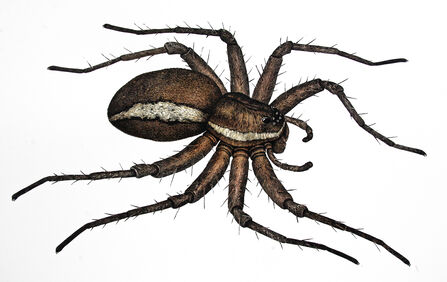
'Dolomedes the Magnificent' hand tinted linocut by artist Sheila Tilmouth.
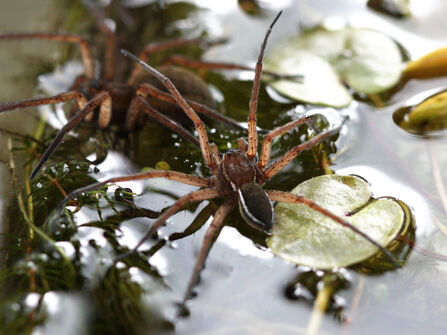
Fen raft spider (Dolomedes plantarius) courtship display. Credit: Sheila Tilmouth.
Life at the water’s edge
Fen raft spiders live in lowland wetlands and grazing marshes, where they can be found around the margins of ditches, canals and fen turf ponds with base-rich but nutrient-poor water.4 These spiders prefer stiff-leaved vegetation surrounding or emerging from the water, with high structural complexity to build their nursery webs. Plants such as the great fen-sedge (Cladium mariscus), water soldier (Stratiotes aloides) as well as other sedges (Carex, e.g., Carex paniculata) and rushes (Juncus) are preferred, whilst other common fen species, such as the common reed (Phragmites australis) are avoided due to their different structure (Dolomedes Conservation, n.d.). Grasses such as purple moor grass (Molinia caerulea) are also not favoured due to their fine leaf structure.5

Spiky, floating rosettes of water soldier (Stratiotes aloides). Credit: Malcolm Storey.
Fen raft spiders are semiaquatic ambush predators. Instead of building webs to capture prey, they patiently sit on emergent stems with their front legs resting on the water surface. They detect vibrations caused by movement of their prey (and predators!) with their sensitive leg hairs. These spiders mostly eat invertebrates such as other spiders, dragonfly larvae and pond skaters, but also small vertebrates like tadpoles and even fish.6 Several predators likely eat fen raft spiders, with documented cases of frogs and insect-eating birds consuming young and adult spiders.4
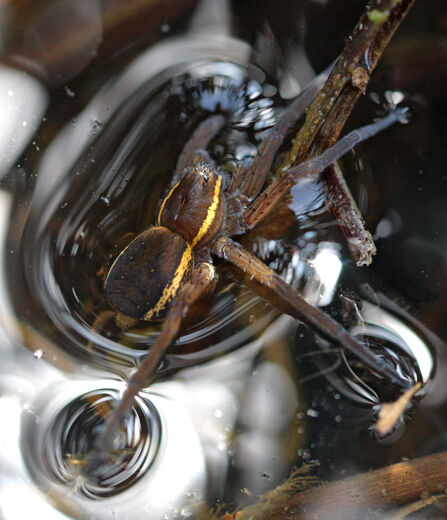
Emerging fen raft spider (Dolomedes plantarius). Credit: Sheila Tilmouth.
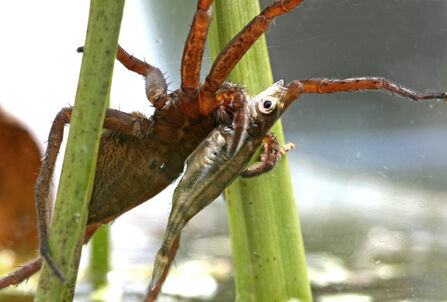
'The Catch' by Sheila Tilmouth.
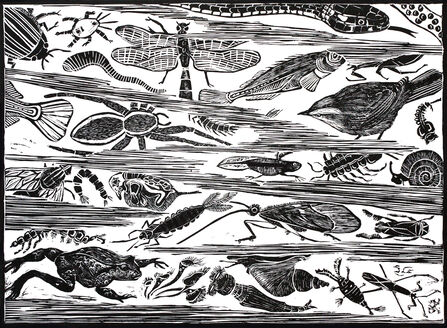
'The Foodchain' linocut by artist Sheila Tilmouth.
Attentive mothers
Fen raft spiders live for one to three years, mating shortly after emerging as adults in late April or May. The females build a large, round egg sac after mating and carry it in their jaws for three weeks. In hot weather, they regularly dip the egg sac in water to maintain humidity around the hundreds of eggs that are hidden inside.

'Female with Egg Sac' wood engraving by artist Sheila Tilmouth
The female then builds a nursery web in stiff-leaved vegetation suspended above water. It has a very dense silk centre, which often holds drops of dew, and anchoring threads that may span 25 cm (H Smith, personal communication, 2026). The eggs hatch inside the egg sac and the tiny spiderlings undergo their first moult before their mother rips open the sac to release them into the nursery web. She will guard them for around a week, until they are large enough to disperse. Nursery webs can be seen from the end of June until early October.
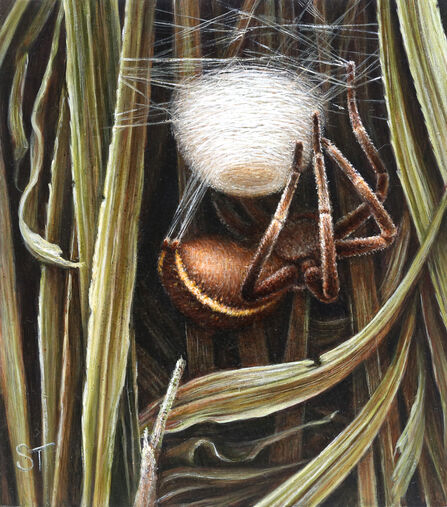
'Spinning the Egg Sac', oil painting on gesso panel by artist Sheila Tilmouth.
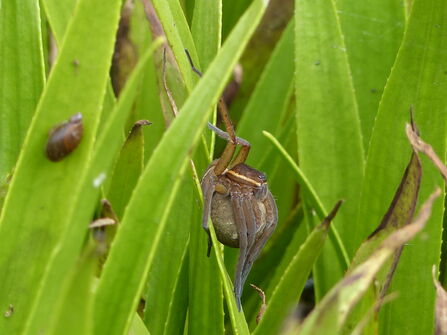
Female fen raft spider carrying an egg sac. Credit: Helen Smith.
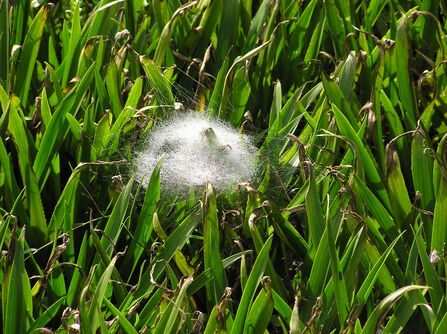
Fen raft spider nursey web at Castle Marshes in Suffolk. Credit: Helen Smith.
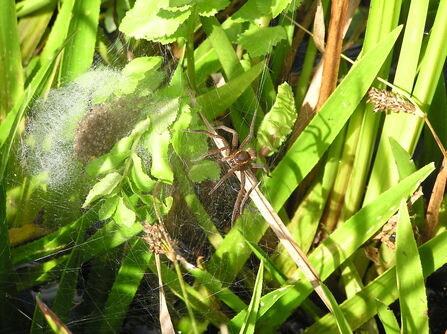
Adult female fen raft spider guarding spiderlings in a nursery web at Pevensey Levels, East Sussex. Credit: Helen Smith.
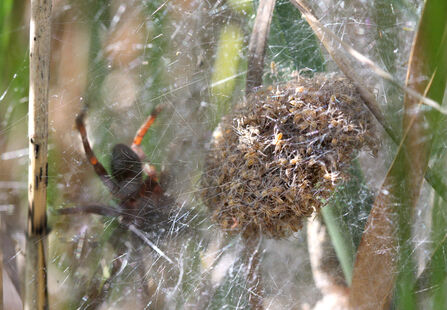
A female fen raft spider guarding her spiderlings before they disperse from the nursery web. Credit: Sheila Tilmouth.
Threatened with extinction by wetland loss and damage
Fen raft spiders are one of the rarest spiders in the UK, and their populations have been declining across Europe.7,8 The fen raft spider is classed as Vulnerable on both the Global and GB IUCN Red List and is listed in the UK BAP List of UK Priority Species. The species is also protected under Schedule 5 of the Wildlife & Countryside Act 1981 which prohibits unlicensed disturbance and collection of specimens. The British Arachnological Society provides a useful summary of the species and its various designations.
In the UK, the fen raft spider is found in a very small number of areas: three natural populations at Pevensey Levels in East Sussex, Redgrave and Lopham Fen in Suffolk, and Pant-y-Sais Fen and Crymlyn Bog near Swansea. Four new populations were established in the Norfolk Broads through a translocation programme in 2010-2015.4 The wide distribution of the remaining natural populations suggests the spider was once much more widespread. Understanding their historic distribution is challenging: they are difficult to detect because of their cryptic camouflage and wetland habitat, they are easily confused with the raft spider, Dolomedes fimbriatus, and historic records are difficult to verify.9
Their current vulnerable status stems from the need for a year-round supply of standing, base-rich water, which is in decline due to the destruction and degradation of the lowland wetland habitats they depend on.10 Reduced water levels due to drainage and abstraction, and declining water quality due to nutrient-rich runoff from nearby agricultural land have contributed to this decline, along with a reduction in open habitats and the threat of sea level rise from climate change in coastal wetlands.
Habitat management for species survival
Habitat management for the fen raft spider in the UK is focused on maintaining and restoring the wetland conditions necessary for maintaining its life cycle and facilitating wider dispersal. Successful management prioritises stable water levels. In practice, management often involves methods such as rotational ditch clearance, as carried out in the Pevensey Marshes.11 This practice prevents the accumulation of sediment and excessive vegetation that can convert open ditches into dry or shaded habitats, while ensuring that some sections remain undisturbed each year to avoid disturbing existing spider populations. Creation and re-excavation of turf ponds is sometimes required to maintain standing water in dry summers, and has been successfully applied in Redgrave and Lopham Fen.4 Freshwater Habitats Trust have created instructions for pond creation suitable for fen raft spiders, summarised in the figure below.

Pond creation for fen raft spiders. Credit: Freshwater Habitats Trust.
Maintaining a suitable vegetation structure is also critical for the species. Control of scrub and tree encroachment close to the water bodies may be necessary to maintain open areas and vegetation that is structurally suitable for building nursery webs.4 Vegetation management can involve periodic scrub removal and rotational cutting of vegetation, such as the mature stands of C. mariscus in Redgrave and Lopham Fen.4 Carefully managed grazing regimes can also contribute to maintaining suitable habitat conditions. Light grazing by cattle or ponies helps maintain open fen vegetation and prevents succession to scrub – this has been the case in Crymlyn Bog in Swansea, where scrub and Common Reed (Phragmites australis) were beginning to encroach open areas of diverse fen vegetation. The introduction of pony grazing and clearance of dense scrub has opened areas of the landscape to allow for a more diverse fen flora.4 However, overgrazing by cattle can also damage marginal vegetation used for nursery webs, negatively affecting the breeding success of the species.
At a broader landscape scale, conservation programmes increasingly emphasise habitat connectivity, creating networks of suitable wetland ditches and marsh pools that allow dispersal and reduce the isolation of populations.4,10 This landscape-scale management approach has been particularly important in grazing marshes in eastern England, where habitat restoration combined with careful water management has facilitated both natural population expansion and successful reintroductions of the species.
Partnership working in Wales and beyond
In Wales, the fen raft spider is currently known to be present on stretches of the Tennant Canal, Crymlyn Bog National Nature Reserve and Red Jacket Fen in the Neath Port Talbot and Swansea area. The earliest confirmed records of the spider date back to 2003 when it was recorded along the Tennant Canal and on Crymlyn Bog. Since 2006 annual surveys, primarily led by Jamie Bevan (Senior Reserve Manager, Natural Resources Wales), have been undertaken on the Tennant Canal and periodic surveys on Crymlyn Bog, the latter as part of Common Standards Monitoring. The spider continues to be recorded on both sites, with the Tennant Canal appearing to be a particular stronghold for the species. Two records of fen raft spider were noted at Red Jacket Fen, a Wildlife Trust of South and West Wales owned site, in 2004 and 2009, although the site wasn’t formally surveyed until 2017. The spider wasn’t recorded during this visit, but suitable habitat was noted, and in 2022, 2024 and 2025 adult females and nursery webs were recorded in low numbers.
Conservation efforts for the fen raft spider received a huge boost in 2023 as the spider was included as one of thirteen ‘target species’ in the Swansea Bay: Coast, Commons and Communities project, (led by Buglife in partnership with Amphibian and Reptile Conservation), part of the wider Natur am Byth species recovery programme, funded by the National Lottery Heritage Fund.
Dedicated staff resources have facilitated and supported continued partnership working with Natural Resources Wales (NRW), including the LIFEquake Project and Wildlife Trust of South and West Wales, and provided capacity to undertake systematic surveys for fen raft spider at greater frequency. The success of the survey work has been made possible with the support of volunteers including students from local universities and colleagues from local councils and eNGOs. This data is allowing us to better understand the population size and extent of the fen raft spider in Wales.
Buglife’s work on the fen raft spider has been guided and supported by national species expert Helen Smith and Nottingham University PhD student Anna Maka, who is undertaking studies on both the Welsh and English populations. A Steering Group brings together partners working to conserve this species across its range.
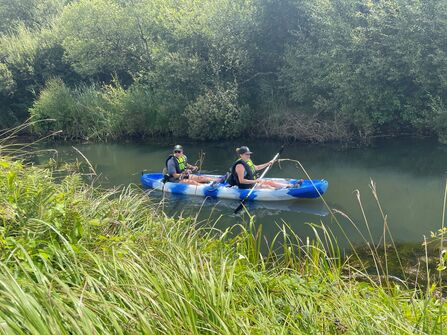
Fen raft spider survey on the Tennant Canal. Credit: Buglife.
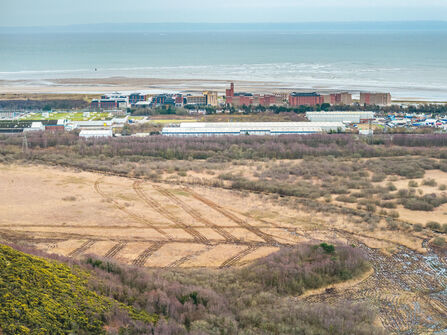
Arial view of Crymlyn Bog in South Wales, showing the Tennant Canal a short distance from Swansea University Bay Campus. Credit: LIFEquake project, Natural Resources Wales.
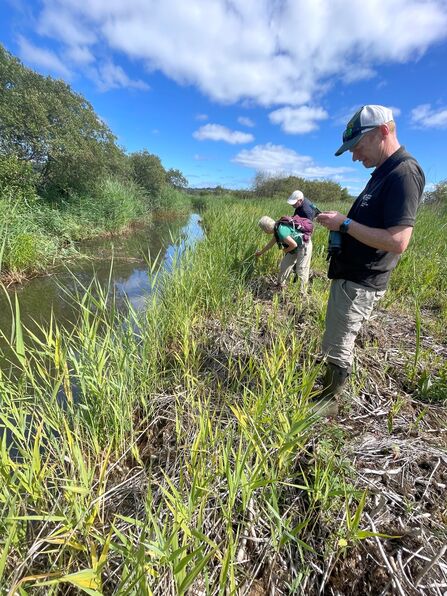
Fen raft spider survey along the Glan-Y-Wern Canal, Crymlyn Bog National Nature Reserve. Credit: Buglife.
Cross-border conservation using spider DNA
As part of a PhD at the University of Nottingham, Anna Maka is studying fen raft spider conservation genomics and environmental DNA (eDNA). This research is helping understand the genetic health and connectivity of fen raft spider populations across the UK, with a particular focus on supporting cross-border conservation between England and Wales.
The fen raft spider is currently restricted to just seven population groups in the UK, found across a handful of sites in England and Wales. These populations are fragmented by degraded wetland habitats, and their long-term resilience is uncertain amid ongoing habitat loss and climate-driven hydrological change. The Welsh population is of conservation significance, and understanding its genetic relationship to those in England is essential for coordinated, landscape-scale planning.
Anna’s research takes a two-pronged approach. The first strand uses population genomics, generating genome-wide data from individual spiders sampled across 15 locations in both England and Wales, to measure genetic diversity and inbreeding, quantify gene flow between and within populations, and identify which groups may be becoming genetically isolated. A central question is whether the Welsh population is genetically distinct or connected to its English counterparts, and how diverse it is by comparison. These insights are vital for determining whether cross-border interventions, such as managed connectivity or habitat restoration, may be needed to support the species' long-term survival.
The second strand involves developing a species-specific eDNA detection assay for Dolomedes plantarius. Environmental DNA, genetic material shed by organisms into their surroundings, can be collected from water samples without directly observing or capturing the spider. This offers a non-invasive, scalable monitoring tool that can complement traditional survey methods, particularly at hard-to-access or low-density sites, including those in Wales. The assay will undergo both laboratory and field validation.
By generating a UK-wide picture of genetic diversity and connectivity, this research directly supports cross-border collaboration between conservation teams in England and Wales. Rather than managing populations in isolation, the genomic data will help both nations make joined-up decisions about where to focus monitoring, whether to enhance connectivity, and how to prioritise habitat management across the species' full range.
Ultimately, this PhD aims to deliver a genome-wide assessment of genetic diversity across all UK populations, a clear picture of connectivity and isolation, and a validated eDNA monitoring protocol. Beyond the fen raft spider itself, this work contributes a transferable framework for using genomics to support species recovery, an approach still underrepresented in invertebrate conservation.
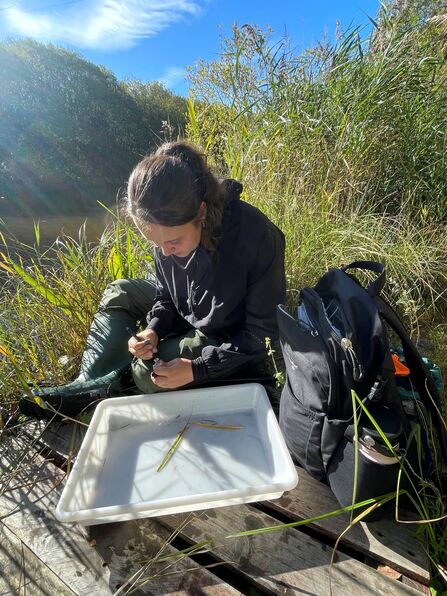
PhD student Anna Maka collecting samples at Red Jacket Fen. Credit: Buglife.

'The Bottleneck' linocut by artist Sheila Tilmouth, depicting loss of genetic diversity in the contracting fen raft spider population.
How to get involved
Submit records
Natural populations of fen raft spider (D. plantarius) are well known at three UK sites, but it is possible that other populations are yet to be discovered. It is also possible that some Dolomedes populations in the UK currently assumed to be the more common raft spider (D. fimbriatus) are in fact D. plantarius. If you come across populations of raft spiders in your area and are unsure whether they are formally identified, or if you think you have spotted a fen raft spider, you can submit a record directly to the national Spider Recording Scheme or contact Dolomedes Conservation for identification advice. More information can be found here.
Volunteer to help with monitoring, recording and site management
Volunteers are often needed to help to monitor fen raft spider populations and to undertake other practical management tasks to help maintain their habitats. If you live near any of the known fen raft spider sites in East Anglia, or near Swansea, please contact the local conservation organisation or Dolomedes Conservation to see how you can get involved.
Several organisations are working to increase awareness of the fen raft spider, including Natural England, the Broads Authority, British Arachnological Society and county Wildlife Trusts. In Wales, Natur am Byth engages communities through creative and species ID workshops, nature walks, and public events. They also engage volunteers to help with practical habitat management and take part in the surveying and monitoring programme.
Fen raft spider monitoring usually involves weekly summer surveys (June–October) of wetlands in the UK to count nursery webs, primarily conducted by volunteers and organisations like Suffolk Wildlife Trust. Data collected by volunteers can then be used to estimate breeding success and population size based on young spiderlings in nursery webs and track species expansion.
......the threat of extinction is a tragic accolade – far better a future in which this species can act out its remarkable life history without the possibility of each generation being the last. Far better a species that can be enjoyed by the many not the few: one that will serve as a tribute to those who have fought to bring our damaged wetlands back to life......by Helen Smith and Sheila Tilmouth (1)
References
- Smith H, Tilmouth S. On the margins: the fen raft spiders of Redgrave and Lopham Fen. Exeter: Langford Press; 2014.
- Buglife. Fen raft spider [Internet]. Available from: https://www.buglife.org.uk/bugs/bug-directory/fen-raft-spider/
- Suter RB, Wildman H. Locomotion on the water surface: hydrodynamic constraints on rowing velocity require a gait change. J Exp Biol. 1999;202:2771–2785. https://doi.org/10.1242/jeb.202.20.2771
- Dolomedes Conservation. Biology [Internet]. Available from: https://www.dolomedes.org.uk
- British Arachnological Society. Summary for Dolomedes plantarius (Araneae) [Internet]. Available from: https://srs.britishspiders.org.uk/portal.php/p/Summary/s/Dolomedes+plantarius
- Nyffeler M, Pusey BJ. Fish predation by semi-aquatic spiders: a global pattern. PLoS One. 2014;9(6):e99459. https://doi.org/10.1371/journal.pone.0099459
- Milano F, Blick T, Cardoso P, Chatzaki M, Fukushima CS, Gajdoš P, et al. Spider conservation in Europe: a review. Biol Conserv. 2021;256:109020. https://doi.org/10.1016/j.biocon.2021.109020
- Milano F, Cardoso P, Mammola S, Smith H, Isaia M. Trends in habitat suitability and conservation status of aquatic spiders in Europe. Biol Conserv. 2022;275:109767. doi:10.1016/j.biocon.2022.109767.
- Smith H. The fen raft spider: from unknown past to uncertain future. Br Wildl. 2020;32:98–109.
- Smith H. The status and conservation of the fen raft spider (Dolomedes plantarius) at Redgrave and Lopham Fen National Nature Reserve, England. Biol Conserv. 2000;95(2):153–164. https://doi.org/10.1016/S0006-3207(00)00030-6
- Sussex Wildlife Trust. Pevensey Marshes Nature Reserve [Internet]. Available from: https://sussexwildlifetrust.org.uk/visit/pevensey-marshes/reserve-profile
With thanks to Helen Smith at the British Arachnological Society for expert review of the text and providing images; Clare Dinham at Buglife for their case study and images; Anna Maka for her PhD case study, and artist Sheila Tilmouth for stunning imagery from her residency studying the spider in all its beauty.