I’ve never liked either/or questions – my answer is usually both or neither. And that includes the concept that you have to choose between science and the arts.
Bringing Peat to Life

Sphagnum mosses in a Welsh bog pool. Credit: Welsh Sustainable Management Scheme.
Anna Chilvers and Clare Shaw introduce a guide to good writing for people who work in peat protection and restoration.
As soon as I started reading I wanted to write. I started with stories in little books that I made from my dad’s printing paper. I illustrated them with pictures drawn in crayon or felt pen. Some of them were terrible, especially the pictures, but I improved. My dad encouraged me to enter a local arts festival writing competition, and I won prizes – runner up the first time, then second, then first. A teacher at school told me she looked forward to reading my published novels. These people fostered a belief in me that I could write, I was creative, I was an artist.
Some teachers thought of me quite differently. I was a science nerd, a maths kid. I wasn’t a dedicated student, I didn’t work very hard. I trusted my natural talent to get me through – and it did up to a point. I sailed through my O levels and won the school maths prize. I chose my A levels, and teachers raised their eyebrows. Maths, Biology, and English Literature with Creative Writing. You should choose three science subjects, they told me. How about Chemistry? Or maybe go for the humanities – Geography? History?
The truth is I would have loved all of these subjects. I stuck to my guns, and found that for A level I needed to work harder to do well in maths. I just about scraped through. So my degree, when I got round to it some time later (having learned something about making an effort), was in English Literature.
Art and science hasn’t always been kept apart. Look at Leonardo da Vinci - painter, draughtsman, engineer, scientist, theorist, sculptor, and architect. The term ‘renaissance man’ is used to describe someone who develops all aspects of their abilities, not limiting themselves to one sphere of life. And even within da Vinci’s work there were not strict dividing boundaries. His scientific drawings are works of art.
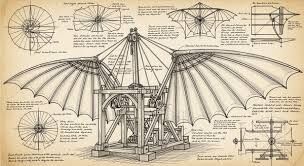
Leonardo da Vinci's flying machine. Da Vinci's drawings merge science, art and imagination without strict boundaries, embracing the spirit of Renaissance innovation.
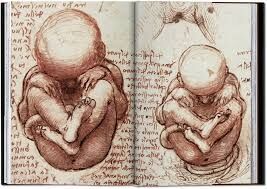
Leonardo da Vinci embraced science, art and innovation during the Renaissance period.
It was probably the so-called Enlightenment which started the division, with its focus on the rational, the application of reason and scientific method. Hot on its heels, and in response, came Romanticism, celebrating subjectivity, imagination and an appreciation of nature. The fork had begun, which is now ingrained into our education system and our cultural psyche – you have to choose, rational scientist or imaginative artist. You can’t be both.
Except of course you can.
Look at the work of mathematician Benoit Mandelbrot, whose visualised sequences of ever dividing numbers have become part of the artistic backdrop for the twentieth century, reproduced as cards, on clothes, in night clubs and music videos. Look at American poet William Carlos Williams who earned his living as a doctor; at Omar Khayyam the 11th century Persian poet, mathematician and astronomer, at Anicka Yi, the artist/biologist who creates art exhibitions of olfactory experiences from microbial cultures; at Cosmo Sheldrake, whose music is made from recordings of birds, trees, fungi and other aspects of the noisy, natural world.

Mandelbrot fractals visualise a simple mathematical formula run through a continuous feedback loop. The resulting images features infinite, repeating patterns - a beautiful representation of fractal geometry.
Science journalist Jeremy Hsu has written about ‘narrative transport’, a state of being immersed within a story. This state will be familiar to all who love reading - it’s often what we are looking for when we read – to be transported to the world of story. Hsu found that readers are more responsive to learning new information when their brain is in narrative transport than when they are reading non-fiction which presents itself as authoritative. Popular scientists such as Brian Cox and Hannah Fry use storytelling and humour to make science more accessible, to break down those boundaries which keep scientific knowledge esoteric, the property of the few. Visual art can do the same.
Recent years have seen a huge explosion of nature writing which is more than facts and figures, writing which embraces a lack of genre boundaries. Writers such as Helen MacDonald, Amy Liptrot, Robert Macfarlane, Luke Turner and many more have written stories of nature which are also personal stories, stories of landscapes and communities, of love and grief and joy. In novels such as The Overstory by Robert Powers, and my most recent novel, Orca and Bird, nature writing takes one step further into fiction.
When we created The Book of Bogs we didn’t want to set any boundaries – between science and art or between genres of writing. We invited contributors to write their response to the bog, and we received a whole variety. Some scientists such as Jen Jones, Mel Giles and Abbi Flint wrote poetry, or creative pieces which blend science with emotions and stories. Some writers work across boundaries on a daily basis, such as Victoria Gatehouse who is a zoologist and poet, who brings her scientific knowledge to her poetry. We received fiction, essays, short poems and two works of beautiful, highly informed art by Michael Malay and Carola Luther, which defy any attempt to be held within categories. The resulting book is a mix of poetry, science, stories, history, politics and much more. The first print run sold out within weeks, and it has already been reprinted.
Last October with The Book of Bogs hot off the press, we took this mix to the IUCN UK Peatland Programme Conference in Derry~Londonderry. We ran a day-long workshop where participants were taken out into the field (and the rain!) in the morning, to identify mosses and liverworts in a local park. In the afternoon they were invited to take part in a number of creative writing exercises, and to write the story of their experience of the morning, and the conference as a whole. As a result of this, we have created the practical resource Bringing Peat to Life. It aims to support everyone working in peat restoration and beyond to unite the science, data and other vital elements of ecology and conservation work with the personal stories and the beauty, humour and commitment which motivates us all, and which speaks powerfully to our readers, colleagues and visitors.
We hope it helps you.
Bringing Peat to Life
If you’d like to find out more about our work, follow our links or contact us here:
Clare Shaw at shaw_clare@hotmail.com
Anna Chilvers at annaruthchilvers@gmail.com
Anna and Clare are also co-authors of a monthly bog-themed blog at blogsandbogs.substack.com

Writers Clare Shaw (left) and Anna Chilvers. Credit: Ffion Atkinson.