
Flower-feeding March fly, Scaptia auriflua. Credit: Marianne Broug via iNaturalist CC BY-NC.
Species showcase: Tabanid flies
Oh, to dream of a summer in Scotland - long hikes up majestic hills, the crisp air filling your lungs, and the sun gracing the heather-clad slopes with its rare, occasional warmth. But wait, what's that persistent buzz? What's that on my neck? Not the gentle hum of bees doing good for the environment and having a purpose, or the distant chirping of birds. No, it's the hellish drone of a horsefly, or a whole army of them, ready to ruin your solace, your outdoor experience, your whole day!
Although they are a vital part of ecosystems, the reputation of horseflies, clegs and deerflies as pesky biters1 means that they are a hard sell on the conservation front. Here however, we highlight their role as ecosystem indicators and nutrient cyclers, providing an answer to the anguished question “what are they useful for?!”
Tabanids go by many names globally: horseflies, deerflies, gadflies, march flies, doctor flies and clegs are just some of them. The family name Tabanidae has its derivation from the classical Latin word ‘tabanus’ which literally translates as ‘horsefly’ and was first used in the current form by Pliny the Younger.
The tabanid family sits within the class Diptera, the true flies. The earliest fossil records of the family come from Purbeck in Dorset, UK, from rocks of the early Cretaceous period between 145 – 140 million years ago. Evidence shows they would have fed on the blood of dinosaurs. Interestingly, unlike some insects which have significantly larger ancestors in the family tree, fossilised tabanids have similar size characteristics to their contemporaries, with the upper maximum size similar to that of the largest extant species.
Tabanids in history and parenthesis
Tabanids provoke such powerful emotions that they have permeated through lore and literature. In Greek mythology, the goddess Hera sent a gadfly to torment Io, the human priestess her husband Zeus had fallen in love with. Shakespeare refers to them in both ‘Trolius and Cressida’, and ‘Anthony and Cleopatra’, where he uses the common Middle English term for them: ‘breese’ (breeze) as a metaphor for torment. ‘Breeze-flies’ is an older British name for members of the family.
The word gadfly (although infrequently used now) also came to have a social meaning, for a person who was a disruptor, asking novel questions and challenging the status quo, particularly directed at systems of power and governance. Perhaps most famously in ‘Apology of Socrates’, his record of Socrates’ defence of himself on charges of corrupting the youth and impiety, Plato records Socrates saying that like the incessant gadfly, “I never cease to rouse each and every one of you, to persuade and reproach you all day long and everywhere I find yourself in your company”. Indeed, the title of a famous novel by Ethel Lilian Voynich ‘The Gadfly’, which was adapted by the playwright George Bernard Shaw, was about a revolutionary fighting against the injustices of the world.
Morphology: eyes to die for
Tabanids are often striking flies. Compared to other biting flies they are large, averaging between 5-25 mm in length, with the largest species up to 33 mm. In general, they are around twice the size of the average housefly. They possess a pair of short, segmented antennae, and like all true flies, a single pair of wings which may be clear, dark or patterned. Their bodies may be even along their length or more distinctly tapered. Females have twin cutting mouth parts (stylets) for cutting skin, and a large additional part called the labrum is used to drink blood. In contrast, males possess similar mouthparts, but they are much weaker, reflecting their non-biting habit.
The most distinctive distinguishing feature of these flies are the large compound eyes which offer them almost 360-degree vision. In males the eyes are larger, often meeting in the middle (holoptic) and covering the majority of the head, whereas females have a distinct gap (frons) separating the eyes in the middle (dichoptic).2 Their eyes are particularly sensitive to UV, blue and green wavelengths allowing them to locate darker hosts. They detect linearly polarised light such as that reflected from shiny dark coat surfaces. Unlike mosquitoes and some other biting species, tabanids are poor detectors of infrared, and are not drawn to heat signatures. This means that wearing light coloured clothing can be a more effective deterrent.3
Many species have stunning patterns in the eyes arranged in bright stripes and spots. The reason behind these eye patterns is not fully understood, but they are more pronounced in females. Therefore, it has been suggested that they likely filter colours, acting to confer a hunting advantage in making hosts more readily identifiable. The appearance of the patterns - swirls, stripes, dots and zig zags - is conserved at the genus level. As the highest diversity of species occur within the Chrysops, Haematopota, Hybomitra, and Tabanus genera, this may suggest an evolutionary advantage to the patterning.
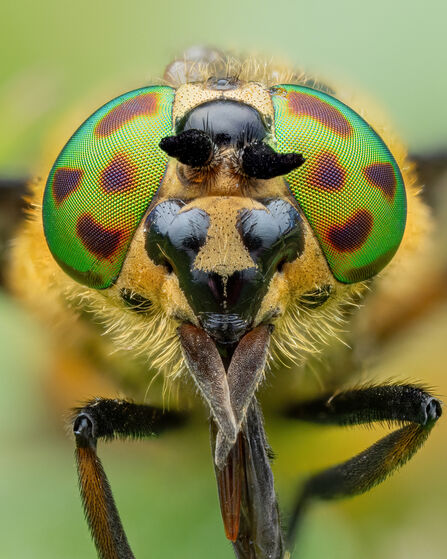
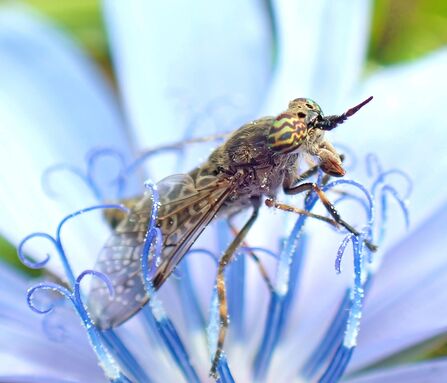
The twin-lobed deer fly, Chrysops relictus. Credit: Manfred Auer via iNaturalist CC BY-NC.
The notch-horned cleg, Haematopota pluvialis. Credit: Vlad Mureșan via iNaturalist CC BY-NC.
Wetland indicators
Tabanid larvae require aquatic, semi-aquatic or wet soil habitats, hence the close association of tabanids with wetland habitats, and why the presence of species can serve as indicators of health in these habitats. The broad-headed horsefly (Hybomitra lurida) and Cheshire horsefly (Atylotus plebeius), both rare, red listed species within Britain, both require pristine, old wetlands.4 Declines in these insects can be closely linked to the drainage and loss of wet woodlands and lowland bogs.
Adult tabanids prefer open habitats and hot, calm conditions. In the UK, the peak months for adults are from mid-May to mid-September. Overcast skies, wind and shade reduce their activity, with adults resting in these conditions. In addition to being found in wetland sites, adults will disperse to areas of pasture and wet meadows in valley bottoms where prey densities are generally higher and there may be a more diverse flora.
Although there have been reports of increased bites in summer on the British mainland,5 tabanid expert Andrew Grayson told us this is likely due to people spending more time in areas where tabanid species are present since the COVID-19 pandemic, rather than there being an increase in Tabanidae numbers. Changes in the climate and the extremes and irregularities of rainfall are thought to be disrupting their lifecycle, and in common with many insect species, they have experienced population declines.
The cycle of life
All members of the tabanid family have a complete metamorphic cycle of egg, larva, pupa, and adult. Females lay their eggs in large clumps, often on the underside of plants near to or over water or wet soils. On hatching, the larvae drop into the water or soil. The larval stage lasts anywhere from 3 months to 3 years depending on the species. The larvae undergo a series of moults before they move to drier soils for a relatively short pupation of around 5-20 days. Like many insects with an aquatic larval stage, the adult stage is generally shorter, with individuals living from 30-60 days.
The larvae within their wetland habitats are aggressive predators, but they are also detritivores, meaning they play an important role in nutrient cycling. They are also an important food source for many species of wetland birds. Similarly, adults are an important link within the food chain, cycling nutrients from the plants they feed on and animals they bite to bats, birds and predatory insects and arachnids, which in turn feed on them.
As adults, despite their reputation as biting flies, it is only the females which require a blood meal to synthesise their egg proteins.6 Some species of tabanids (Chrysops) act as generalist pollinators in the UK, while Atylotus latistriatus is often found on sea lavender. While no species act as the sole pollinators for any UK plant species, there is a sub-family (Pangoniinae – largely absent from Europe) within the tabanid family where both male and female are solely pollinators and some within the genus are highly specialised pollinators of specific plant species.

Philoliche umbratipennis, a species of long-tongue horsefly from the sub-family Pangoniinae. Found in South Africa, it is a specialist pollinator and demonstrates the impressive diversity within the Tabanidae family globally. Credit: Marie Delport via iNaturalist CC BY-NC.
Why does it hurt so much?!
While some species make a more audible low-pitched buzzing sound, species of cleg are often only heard just before their bite. Unlike other familiar biting flies such as mosquitoes or midges, tabanids do not swarm, although they may congregate around livestock. They are fast, agile and aggressive when hunting, and as anyone who has encountered them in the field or garden can attest, they are persistent once they have located a host. This behaviour can cause significant distress to livestock, particularly when numbers of flies are high, as grazing becomes interrupted. However, this can serve an important function in natural systems, as herbivore herds move away from areas where large numbers of flies are found, in turn reducing grazing pressure on habitats.
And what of that bite? It’s an unavoidable fact that the bite of tabanids is generally painful. This is for a couple of reasons. Firstly, they are generally adapted to bite animals with thick hides (meaning some species can even bite through denim). This means that unlike other biting insects that pierce the skin to feed slowly, tabanids often use speed and a sharp blade-like mouthpart to cut the skin. Secondly, the type of animals they are adapted to bite frequently cannot easily swat them, relying on flicking their tails or attempting to shake them off their heads and fore quarters. This means there is no need to be covert when they bite, so it was neither necessary nor useful for tabanids to evolve anaesthetic. The largest biting flies globally are also found within the family.
To minimise the risk of bites, loose clothing in light colours is the best defence, as even strong insect repellents do not always deter these flies. There is also some evidence that stripes and patterns may act to deter them, and a study from the University of Bristol suggested that this may be the evolutionary driver for the stripes of zebras.3
In common with many biting insects, tabanids play a role as pathogen vectors. However, unlike many insect vectors which carry pathogens internally they are ‘mechanical vectors’ meaning that pathogens are transmitted via infected mouthparts. This is because of their interrupted feeding methods, where they will take multiple small meals from several hosts rather than a single meal. In the UK, they are not considered to be a vector of disease to humans. They can be a vector of equine infectious anaemia, a notifiable disease of horses, although there have been no outbreaks in the UK since 2012. Their primary impact on livestock is a biting nuisance which can cause increased stress levels and subsequent weight loss and low milk yield.7,8
Tabanids in the UK
The UK has 30 confirmed species of tabanids across horseflies, clegs and deerflies, largely from four genera: Tabanus, Haematopota, Chrysops, and Hybomitra. Some species are red listed in the UK and found at only a limited number of sites. The family is distributed throughout the UK, but most species have a southerly distribution in Britain only, some being restricted to coastal regions.
Amongst the species present in the UK, Tabanus sudeticus is the largest, with a body length of around 25-30 mm and a wingspan of up to 50 mm - commonly cited as the heaviest European fly species. While present across British mainland, the species distribution is concentrated in the west of the country and it is extremely rare in Northern Ireland. Unlike smaller species however, and perhaps mercifully, T. sudeticus rarely bites humans.

Giant dark horsefly, Tabanus sudeticus, one of the world’s largest species of fly. Credit: Theo Chass via iNaturalist CC BY-NC.
Tabanids globally
Globally within the Tabanidae family there are approximately 4,500 species described, with over 130 different genera, the most specious of which are Tabanus (horse flies), Chrysops (deer flies), and Haematopota (clegs). The genus Tabanus contains ~1,300 species. The family is represented globally except for polar regions. The highest species diversity is found in the neotropical regions of South America with approximately 1,200 species being represented in this region. Tropical rainforests with their high humidity provide the ideal conditions for larval development. In comparison, there are around 170 species found in Europe.
Whilst our encounters with tabanids are often fleeting (and sometimes painful), globally some species standout amongst flies in the order Diptera for their spectacular appearance.
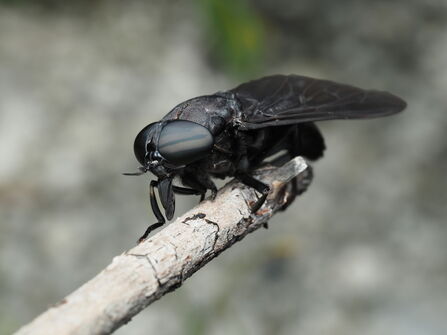
Black horsefly, Tabanus atratus. Credit: Lucas Garriga via iNaturalist CC BY-NC.
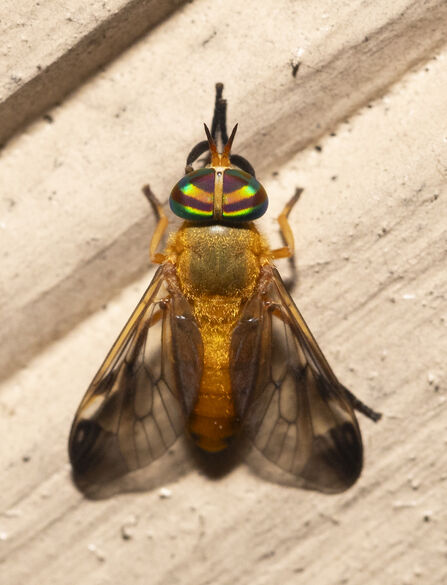
Yellow fly of the dismal swamp, Diachlorus ferrugatus. Credit: Eliot Van Otteren via iNaturalist CC BY-NC.
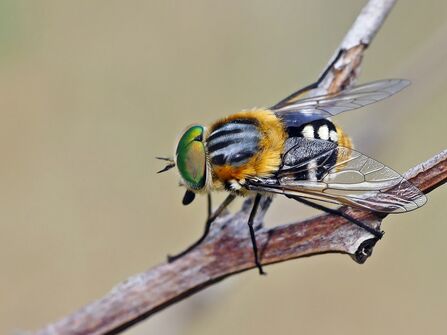
Flower-feeding March fly, Scaptia auriflua. Credit: Marianne Broug via iNaturalist CC BY-NC.
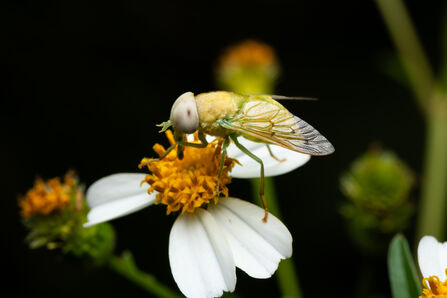
Green horsefly, Chlorotabanus crepuscularis. Credit: Eli4712 via iNaturalist CC BY-NC.
Wetland habitat loss and other threats
Regarding conservation status, the family is poorly assessed, with only three species included in the IUCN Red List of Threatened Species: one as Data Deficient and one as Vulnerable. Stonemyia velutina was listed as Extinct in 2007, as no records were made since 1942. However, this species was identified again in 2023.
As almost all tabanids are dependent on wetlands for at least parts of their lifecycle, their fate is closely tied to that of their habitat. Wetlands are one of the world’s most threatened ecosystems, which is likely to put many of these species at risk.
The loss of pastureland to climate change, development pressures and soil erosion are also threats to these unique flies. Shifts from extensive to intensive agriculture can also have a negative impact. While the lower densities of livestock in extensive systems reduces the number of available hosts for the flies to feed on, it is far more challenging to implement controls such as lethal traps at scale. Unimproved pasturelands, in mosaics with wetland areas that have not been drained, are more typical of extensive grazing systems and offer optimal breeding conditions for tabanids.
Horseflies are a source of frustration to many, and their control has led to the development of traps which can be placed near to livestock paddocks (particularly equestrian) to try to control their numbers. Studies have found that these traps are indiscriminate and can lead to large amounts of ‘by-catch’. While countries like Germany have implemented restrictions or bans on horsefly traps, in the UK there is no legislation around their usage.
While many UK species are naturally scarce, some horsefly species are UK red listed, of which four are classed as Endangered: pale giant horsefly (Tabanus bovinus), Cheshire horsefly (Atylotus plebeius), downland horsefly (Tabanus glaucopis) and scarce forest horsefly (Hybomitra solstitialis). A further four are listed as Vulnerable or Near Threatened.9 No UK cleg or deerfly species are internationally red listed. The loss of levels habitats and pristine mire habitats along with reductions in pasture are key drivers of declines in these species.
While many people may breathe a sigh of relief at the thought of fewer biting insects in the environment, it is important to recognise the role that they play within their habitats. Losses driven by habitat conversion are likely to affect multiple species, so more visible (and annoying) species can be vital indicators. While the loss of charismatic mammals or bird species can be more immediately obvious, the impact of the loss of smaller creatures from the food chain should not be underestimated, and they should also be considered an important target for conservation efforts.
Acknowledgements
We would like to extend our thanks to the North West Invertebrates group for their support, and in particular Andrew Grayson for the time he spent reading and offering expert insight into this work.
References and further reading
- The Guardian. Country diary: horseflies are a biting scourge throughout the land [Internet]. Available from: Country diary: horseflies are a biting scourge throughout the land | Insects | The Guardian. Accessed 10 Mar 2026.
- Baldacchino F, Desquesnes M, Mihok S, Foil LD, Duvallet G, Jittapalapong S. Tabanids: neglected subjects of research, but important vectors of disease agents! Parasites Vectors. 2014;7:26.
- Tombak KJ, Gersick AS, Reisinger LV, Larison B, Rubenstein DI. Zebras of all stripes repel biting flies at close range. Sci Rep. 2022;12:18617. doi:10.1038/s41598-022-22333-7.
- North West Invertebrates. The status and distribution of the horseflies Atylotus plebeius and Hybomitra lurida on the Cheshire Plain area of North West England [Internet]. Available from: The status and distribution of the horseflies Atylotus plebeius and Hybomitra lurida on the Cheshire Plain area of North West England. Accessed 14 May 2026.
- Natural History Museum. Are horsefly bites on the rise? [Internet]. Available from: Are horsefly bites on the rise? | Natural History Museum. Accessed 12 Mar 2026.
- International Congress of Dipterology. Fly Times. Issue 71. 2023. Available from: Fly Times, issue 71 (2023). Accessed 10 Mar 2026
- Phillips C. Horse flies: how to avoid them plus how to treat horse fly bites [Internet]. Horse & Hound. 2025 Jun 24. Available from: https://www.horseandhound.co.uk/horse-care/horse-care-tips/how-to-deal-with-horse-fly-bites-56463. Accessed 20 Mar 2026
- Landkreis Waldeck-Frankenberg. What to consider when using horsefly traps [Internet]. Available from: What to consider when using horsefly traps | landkreis-waldeck-frankenberg. Accessed 11 Mar 2026.
- oint Nature Conservation Committee (JNCC). GB Red List Dashboard [Internet]. Peterborough: JNCC. Available from: https://jncc.gov.uk/our-work/gb-red-list-dashboard/ [jncc.gov.uk]. Accessed 11 Mar 2026.
Further reading
United Nations. World Wetlands Day [Internet]. Available from: World Wetlands Day | United Nations
North West Invertebrates. Atylotus plebeius (The Cheshire Horsefly) [Internet]. Available from: Atylotus plebeius (The Cheshire Horsefly) - North West Invertebrates
North West Invertebrates. A study of horseflies (Diptera: Tabanidae) on Cheshire Plain area mires in 2022 [Internet]. Available from: A study of horseflies (Diptera: Tabanidae) on Cheshire Plain area mires in 2022
North West Invertebrates. A survey of horseflies (Diptera: Tabanidae) on mires in the Cheshire Plain area during 2019 [Internet]. Available from: A survey of horseflies (Diptera: Tabanidae) on mires in the Cheshire Plain area during 2019