
Aerial view of Crymlyn Bog with Swansea University Bay Campus in the distance. Credit: LIFEquake project, Natural Resources Wales.
Peatlands Under Pressure
IUCN UK Peatland Programme Conference 2026
9 - 11 June, Swansea, Wales
Our 2026 conference took place at Swansea University’s Bay Campus—a stunning coastal setting with its own beach, seafront promenade and on-site accommodation. This unique location provided an inspiring backdrop for the event and an ideal base for exploring the rich and varied peatlands of south Wales.
The 16th conference was themed ‘Peatlands Under Pressure’, bringing together experts and practitioners to examine the challenges facing peatlands today—from development pressures and intensive land management to the impacts of a changing climate. Alongside these challenges, the programme highlighted the growing opportunities to scale up nature-based solutions and strengthen the role of peatlands in addressing environmental change.
We are currently in the process of editing conference footage and are sharing videos here as they are completed - so you can revisit key discussions or catch up if you weren't there. Our opening plenary videos are now available below.
Day 1 Presentations
The conference opened with plenary sessions introducing the work of the IUCN UK Peatland Programme, introducing progress for peatlands in Wales and addressing peatland pressures from climate change to development. The day also featured posters, exhibitions and networking, as well as the return of our Peatland Cinema.
Opening Plenary: Welcome and Keynotes
The conference opened with welcomes from IUCN UK Peatland Programme, Welsh Government and Natural Resources Wales, highlighting the importance of placing peatlands at the centre of policy, culture and practice in Wales and beyond. Presentations explored both local success stories, such as the restoration of Crymlyn Bog, and wider challenges from climate change, as well as introducing the Joint Nature Conservation Council's developing Peatland Indicator Framework.
Putting Peat Centre Stage in Wales (https://youtu.be/HHSA3jzJSGM)
An introduction to action for peatlands in Wales and their importance in Welsh culture and language.
Gareth Thomas | Crymlyn Am Byth (https://youtu.be/A1AKvP7Xpf4)
‘Crymlyn Am Byth’ – Securing quaking bog and supporting landscapes at Wales’ largest lowland fen for LIFE.
Kim Dowsett | Well-Adapted UK Landscapes (https://youtu.be/s9_kX9lMXBw)
Climate Change Committee update on the main findings from the independent assessment for the UK’s 4th Climate Change Risk Assessment and the Well Adapted UK Report – published in May 2026.
Hannah McGrath | Work Towards a UK Peatland Indicator Framework (https://youtu.be/i88iy1amDYk)
Update on the work of the Joint Nature Conservation Council to develop a UK Peatland Indicator Framework.
The Sustainable Growth Paradox: Can We Resolve the Conflicts Between Development and Peatlands?
This plenary examined the growing tension between development ambitions (including energy, infrastructure and land use change) and peatland protection across the UK. As new planning frameworks, land-use strategies and national policy statements emerge, decisions about development on peatlands are becoming increasingly complex and contested.
The session brought together perspectives from policy, planning, development, regulation and academia to explore whether current systems can reconcile climate, biodiversity and societal objectives - or whether change is needed.
#PeatConf26 | The Sustainable Growth Paradox (https://youtu.be/wT2uDn7z2Oc?si=cQR5bIxANKjpFHAw)
#PeatConf26 | The Sustainable Growth Paradox.
Peatland Cinema
Our Peatland Cinema featured an eclectic mix of thought-provoking and inspiring short films from restoration partnerships, artists and communications experts from across the UK. Join us on a journey of sound and vision exploring Welsh language, musical interpretation of peatlands, young voices and serious messages introduced by the filmmakers.
#PeatConf26 | Miranda Whall | When Peat Speaks: A Boggy, Gassy, Bubbly Ensemble (Part One).
#PeatConf26 | South West Peatland Partnership | The Living Layer (https://youtu.be/fsc1deIO2Uk)
#PeatConf26 | South West Peatland Partnership | The Living Layer.
#PeatConf26 | Peatland ACTION | Glen Dye Moor Case Study (https://youtu.be/8-48PExhZik)
#PeatConf26 | Peatland ACTION | Glen Dye Moor Case Study.
#PeatConf26 | Peatland ACTION | Mòinteach na h-Alba dha Muinntir na h-Alba (Scotland's Peatlands for Scotland's People).
#PeatConf26 | Moors for the Future | Wildfire Comms: An Experiment to Reach Young Audiences.
#PeatConf26 | Manon Awst | Am I Peat-Compatible? (https://youtu.be/Vk0G9gSJt2E)
#PeatConf26 | Manon Awst | Am I Peat-Compatible?
#PeatConf26 | The Art and Energy Collective and RE-PEAT | Peat-Fest South-West Manifesto.
Posters
Please see a selection of posters from the conference here:
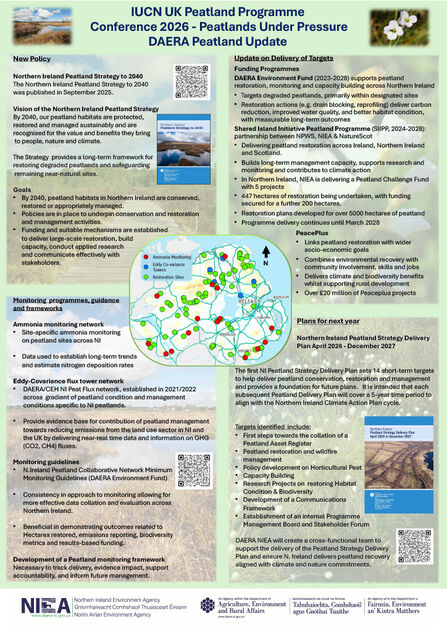
DAERA - Four Country Poster IUCN UK Peatland Programme Conference 2026
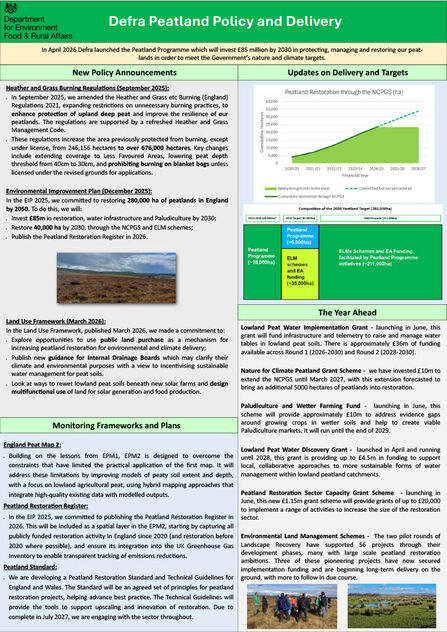
Defra - Four Country Poster IUCN UK Peatland Programme Conference 2026
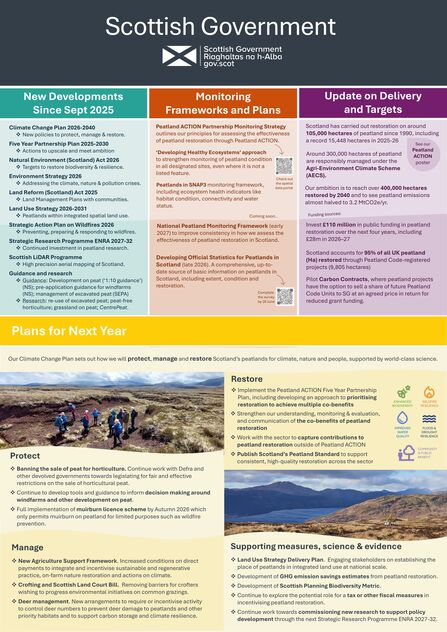
Scottish Government - Four Country Poster IUCN UK Peatland Programme Conference 2026
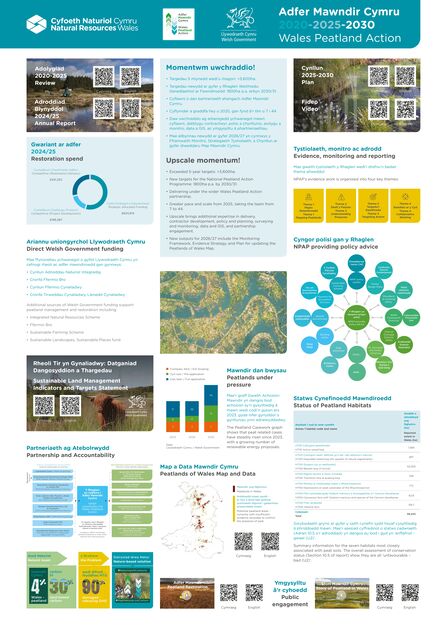
Welsh Government - Four Country Poster IUCN UK Peatland Programme Conference 2026
Day 2 Field Trips
Day 2 of the conference featured a full programme of field visits, our gala dinner and conference tradition: twmpath dancing.
Field Visit A+B: Crymlyn Bog National Nature Reserve, Swansea
‘Against all odds’ - Transition Mire & Quaking Bog restoration on the edge of Wales’ second city
The mosaic of peatland landscapes that converge on Crymlyn Bog and the neighbouring Pant y Sais Nature Reserve offer a potentially unrivalled example of triumph over adversity in-keeping with this year’s conference theme of ‘Peatlands under pressure.
Situated only a few miles from the 250,000 population of Swansea, (Wales’ second city) and flanked by former landfill sites, motorways, remnants of oil, coal and copper industries and an extensive network of canals, Crymlyn is living proof that even when faced with challenges such as these, nature still finds a way!
The Crymlyn Nature Reserve, home to the rare fen raft spider is approximately 300ha in size and comprises excellent examples of fen, transition mire and quaking bog habitats. A main focus of the LIFEquake peatland restoration project delivered by Natural Resources Wales and partners, Crymlyn truly is a diamond in the rough!
Visit synopsis
The Crymlyn Visitor Centre was the perfect start and end to a 1.4km circular walk which took visitors through the many different historic landscapes which also include the “Balloon Field” – a CADW designated site where Second World War barrage balloons were flown in an attempt to safeguard the Llandarcy Oil Refinery which once stood at the Eastern edge of Crymlyn Bog.
This site visit, delivered by LIFEquake Project Manager Gareth Thomas; Crymlyn Reserve Manager Jamie Bevan, and leading peatland hydrologist Dr Rob Low, offered a detailed understanding of the many challenges affecting the peatland at Crymlyn, the rich and varied history that has shaped and threatened its existence and the many different interventions that are being delivered to secure its future. Members of the Natur Am Byth / Buglife team also delivered a talk on their work monitoring populations of the fen raft spider found onsite – the only habitat in Wales where this rare species can be found.
Management of invasive species, mowing, canal clearance and brook remediation all featured in this half-day tour.
Field Visit C+D: Llyn Llech Owain Country Park (SSSI)
Management of a County Country Park
Llyn Llech Owain country park is an area of 73 hectares which is owned and managed by Carmarthenshire County Council (CCC) for nature and outdoor recreation. The name, translated as ‘lake of Owain’s slate slab’, references the legend that Owain forgot to replace the slab over a well, resulting in the creation of a lake.
In 1993 the lake was designated as a Site of Special Scientific Interest for being a shallow, highly acidic waterbody which is uncommon at low altitudes for the area. A section of the site is additionally a Special Area of Conservation for wet and dry heathland habitat.
Surrounding the waterbody is a raised bog with some peat depths exceeding eight meters. The National Peatland Action programme has been working with CCC to design a phased approach to improving the hydrological integrity of the peatland. Phase 1 of restoration has already been complete via the creation of 807m of low elevation contour bunds and planning is underway for the next phased approach.
The site visit, led by NPAP, addressed considerations of peatland restoration within a County Country park, designated land and pressures to restock conifer plantations on peatland habitat.
Field Visit E: Dr Beynon's Bug Farm and Dowrog Common, St Davies, Pembrokeshire
Marsh Fritillary Reintroduction and Managing ‘Fen Mosaic’ Lowland Heath Habitat
This visit featured two nearby sites situated centrally on the beautiful St Davids peninsula: Dr Beynon’s Bug Farm and Dowrog Common, which forms part of the North West Pembrokeshire Commons SAC, a nature corridor that runs from St Davids Airfield Heaths SSSI out to the wild north Pembrokeshire coast.
The Bug Farm
The Bug Farm is a cutting-edge, award-winning Welsh nature recovery project and the brainchild of visionary ecologist, farmer and entomologist Dr Sarah Beynon. Three separate farms come together to create a dynamic 65-hectare habitat corridor, nature reserve, research centre and visitor attraction.
With a mixture of active nature recovery and an element of rewilding, over the past 13 years, the intensively farmed mixed beef and arable farm has transformed into a thriving nature reserve and its marshy grasslands are due to be designated as a SSSI in 2026/2027. Large-scale nature recovery projects include heath creation, meadow creation, arable habitat creation, marshy grassland management, woodland creation and freshwater habitat creation.
The Bug Farm has led a project over the past 6 years that has focussed on bringing back the locally-extinct marsh fritillary butterfly to the St Davids peninsula. This will be the first marsh fritillary reintroduction in Wales and the butterflies will be in captivity in rearing pens at The Bug Farm during the visit.
Dowrog Common
Dowrog, found between Waun Fawr and Tretio Common, has received LIFEquake peatland restoration project interventions over the last two years.
At 101 hectares, Dowrog boasts variety of habitat perhaps best described as ‘Fen Mosaic’ Lowland Heath. This historic landscape transitions through a wide variety of vegetation communities from dry heath to swamp.
Dowrog’s fascinating history ranges from forming part of the ‘Pilgrims Trail’ to St Davids; the enclosure of the Commons Act and a ‘Ty Unnos’ house built in the middle; to a more industrial past with a ‘mill leat’ dug across the common supplying water to the old corn mill nearby.
Dowrog Pool, formerly open water, sits in the depression on the North Western end of the site, which as grazing pressures have decreased over the years has vegetated over by dominant greater tussock sedge. Over the last 2 years, works have been carried out to remove sedge to create more open water and promote the expansion of the last remaining areas of transition mire.
LIFEquake actions around mowing, transition mire scrapes and grazing with multiple cattle herds on a common will all feature in this site visit. Delegates will gain a good understanding of the area’s complex hydrology, Dowrog’s backstory and how its future is being safeguarded.
Visit synopsis
The visit began and ended at The Bug Farm. In a bespoke visit, led by Dr Sarah Beynon, delegates explored the farm's new Nature Recovery Centre - an educational centre about our relationship with food, farming and nature in the past, present and future. Sarah guided delegates on a farm walk through the marshy grassland, Devil’s-bit scabious plug planting and heath habitat creation sites and to St Davids Airfield Heaths, a SSSI site that is part of the SAC and grazed by The Bug Farm's cattle. Delegates could see Monil virtual fence collars in action on the cattle (and see examples of NoFence collars) and wander back through the new woodlands, arable fields and meadows.
A walking tour of Dowrog Common was delivered by LIFEquake project partners Chris Lawrence of NRW’s Pembrokeshire Environment Team, Nathan Walton, Reserves Manager Wildlife Trust West Wales, and Laura King, Peatland Hydrologist at Rigare.
Field Visit F: Bannau Brycheiniog National Park (Brecon Beacons)
Restoring Dry Modified Upland Blanket Bogs in Bannau Brycheiniog
(Brecon Beacons National Park)
Delegates went for a full‑day field visit to the spectacular uplands of Bannau Brycheiniog National Park, where they explored the challenges and opportunities associated with restoring dry modified blanket bog on the southern margins of the National Park.
This collaborative visit brought together expertise from Bannau Brycheiniog National Park Authority, the National Trust, and Dŵr Cymru/Welsh Water, offering a unique opportunity to see current restoration work first-hand and discuss emerging approaches with practitioners working across the landscape.
Visit synopsis
Participants visited active restoration sites and took part in guided discussions on:
• Restoration techniques for degraded, dry modified blanket bog.
• Anticipated changes in intervention methods in response to evolving evidence and conditions.
• Place within wider upland systems, including commons management and grazier involvement.
• Key pressures such as wildfire risk, illegal off‑roading, erosion, and visitor impacts.
• Drivers for restoration: nature recovery, carbon conservation, and catchment/water management.
• Collaborative working at landscape scale, comparing operations, approaches, and lessons learned.
• Integration with other land management initiatives, including Ffemio Bro.
• Natural capital considerations—opportunities, challenges, and the scoping of scheme viability within the National Park.
• Knowledge gaps and research needs, including how climate and land‑use change influence bog function, resilience, and restoration outcomes.

Brecon Beacon Field Visit Group Picture by Sam Ridge, BBNPA
Field Visit G: Mynyddoedd Rhigos Mountains
Forest-to-bog Restoration
The Rhigos Mountains are the most southerly mountain range in Wales. They represent the watershed catchments of the famous South Wales valleys within which was located the heavy industry (mining and steel) that dominated the region for so long and many of the major cities and towns of South Wales.
Peatlands are extensive across the Rhigos Mtns, however, in a UK context they are climatically relatively marginal and high(er) risk from climate change. Post-war, a significant area of the mountains and peatlands were planted with conifers and a 76-turbine wind farm constructed ~10 years ago. The conifer plantations have reached maturity and are being felled and the underlying peat systems are being restored to a land cover ‘lost’ for several decades.
Visit synopsis
Delivered by Swansea University, Natural Resources Wales, the Lost Peatlands Project and Vattenfall (Pen y Cymoedd Wind Farm), this visit entailed a walk along forestry roads and trails, down the spine of the Rhigos Mountains, along which delegates learned and experienced the story of the mountains and the challenges and success of the extensive forest-to-bog peatland restoration works taking place there; including:
- The unique geographical and environmental context of the Rhigos Mtns: considerations and constraints
- Impacts of conifer afforestation on peatland systems
- Post-forestry recovery targets
- The Pen y Cymoedd Wind Farm
- Afforested bog restoration: approaches trialled, approaches delivered at scale (the innovation of restoration techniques suitable for these mountains)
- Grazing forest to bog restoration sites
- Conifer (and other tree species) regeneration and control
- Peatland system recovery – the impacts of the restoration (monitoring and research findings)
Field Visit H: Figyn Blaen Brefi, Ceredigion
Restoration – Before and After
Fign Blaen Brefi translates as the bog at the head of the Brefi (river). This partially restored site is part of the National Peatland Action Programme with works commenced in 2020 and undertaken in a phased approach due to significant water vole presence. This peatland was also studied in 1938 with a detailed early habitat mapping, followed by further ecohydrological surveys in 2022.
The site mixes a variety of NPAP restoration themes and encompasses the entire peatland hydrological unit including the SSSI and the undesignated afforested margins. Contour bunds, peat dams and erosion control have been completed to date. The site also presented an opportunity to explore unrestored degraded bog dominated by Molinia, erosion and afforested areas.
During this visit, delegates explored a range of implemented restoration techniques and how NPAP are planning the next phases of restoration across the site, including eroding and afforested blanket bog.
Field Visit J+K: Cors Caron South East and North East Bogs
Welsh Raised Bogs LIFE Project raised bog peatland restoration techniques –
2 years on, lessons learnt, and After-LIFE plan
Cors Caron National Nature Reserve is huge 800ha wetland habitat comprising of three raised peat bogs, surrounded by reedbeds, fen, wet grassland, woodland, waterways and ponds. The site is one of the finest examples of a raised bog complex in the UK and supports a rich mix wildlife such as hen harrier, curlew and skylark, whilst the peatland bustles with an array of bryophytes, flowering plants, and insects.
The field visit focused on the raised bog peatland restoration work that took place as part of the Welsh Raised Bogs LIFE project which finished in June 2024. Now 2 years later – National Peatland Action Program staff looked at restoration successes, failures, and lessons learnt.
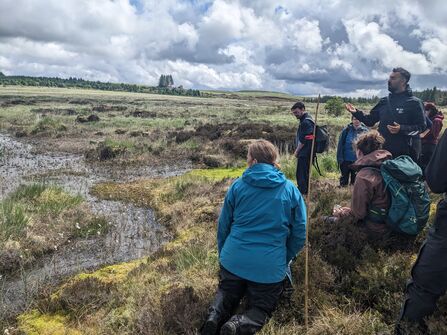
Figyn Blaen Brefi - Bog at the head of the River Brefi
#PeatConf26 Field Trip by Tanja Rath
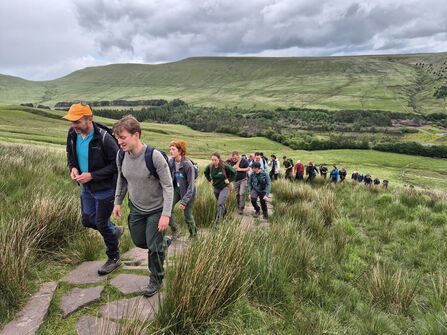
Bannau Brycheiniog (Brecon Beacon) National Park
#PeatConf26 Field Trip by Emma Hinchliffe
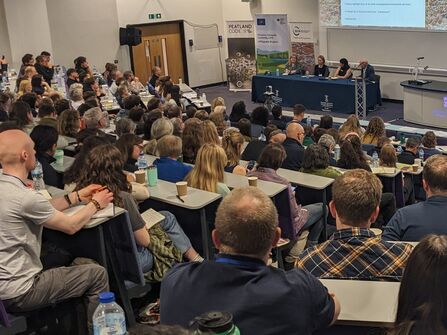
Panel Discussion The Sustainable Growth Paradox by Tanja Rath
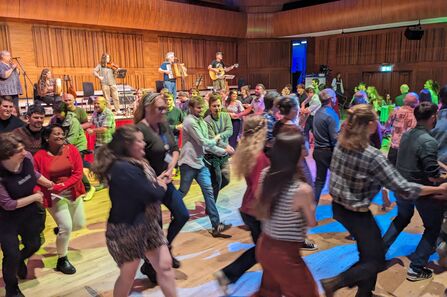
Twmpath Dancing with Allan yn Y Fan by Tanja Rath
Day 3 Topic Deep Dives
On Day 3, delegates could choose two of 18 diverse workshops ranging from data projects to zine making.
This year, the IUCN UK Peatland Programme conference was collaborating with the Landscape Finance Lab to deliver their Peatland Finance Collective in-person workshops, which were open to all delegates. The Peatland Finance Collective is a Community of Practice formed in 2023 to bring together peatland landscape restoration teams from across the UK and Ireland. Through in-person workshops (Edinburgh 2023, Dublin 2023, Leeds 2025, Exeter 2025) and virtual convenings, it facilitates peer learning on finance challenges, tools and best practice. It is coordinated by the Landscape Finance Lab with support from WaterLANDS.
Mapping Peatlands to Protect Them - Crymlyn Bog, Swansea
Mapping the location, depth and condition of peat is vital if we are to raise its profile, ensure peatlands are preserved and target scarce resources towards the best practicable restoration projects. The England Peat Map (EPM) was published in May 2025, and is now in a second stage of works investigating ways of increasing model accuracy. An important aspect of this is testing modelling approaches against data collected in the field.
In this workshop, the EPM team introduced their field survey protocol and investigated ways of ensuring that measuring peaty soil presence and depth is as reliable as possible.

England Peat Map Workshop by Sarah Lamb and Anne Stefaniak

England Peat Map Workshop at Crymlyn Bog by Tanja Rath

England Peat Map Workshop at Crymlyn Bog by Tanja Rath
Early Career Pathways in Peatlands: Research, Careers and Connection
The UK peatland sector has expanded rapidly in recent years, driven by ambitious restoration targets that rely on strong science, policy, practice and finance. Alongside this growth is a diverse and expanding network of early career researchers and professionals navigating different pathways into peatland-related work.
This interactive session created a dedicated platform for early career professionals to:
- Share emerging peatland research and applied work at a national conference.
- Hear honest reflections on different career pathways across science, policy and practice.
- Build peer-to-peer networks and connections with others working in the peatland sector.
Through short talks, career stories, facilitated discussion and an informal networking activity, the session aimed to support confidence, visibility and connection among early career peatland professionals.
Kieran Boyd | The Arthropods of Irish Blanket Bogs (https://youtu.be/3iUZ-rS73tA)
The Arthropods of Irish Blanket Bogs and Their Application as Indicators.
Joey Pickard | Carbon Aspects of Forest to Bog Restoration (https://youtu.be/dp2aa5Am6wo)
Carbon Aspects of Forest to Bog Restoration.
Laura Hughes-Dowdle | Peatland Hydrogeophysics (https://youtu.be/yxcXM3hTxyc)
Evaluating the Outcomes of Forest-to-Bog Restoration in the South Wales Uplands.
Nadia Murphy | Early Career Pathways: My Personal Journey (https://youtu.be/AgpuM6Q5EyE)
Nadia Murphy shares her early career journey.
Katy Ross | Pursuing Peat: From the Pennines to Paludiculture (https://youtu.be/gE2wAqZCq_g)
Pursuing Peat: From the Pennines to Paludiculture.
Alice Whittle | A Review of all the Pies I've Tried (https://youtu.be/oByIF6RsiJM)
Alice Whittle's early career journey.
Early Career Pathways in Peatlands Panel Discussion (https://youtu.be/IxlqOyxwU0o)
Early Career Pathways in Peatlands Panel Discussion.
Fighting Fire with Nature: exploring climate hazard impacts on peatlands
Our peatlands face increasing challenges in the face of a changing climate while simultaneously playing a key role in mitigating climate impacts. In this workshop, colleagues from NatureScot and Scotland’s Peatland ACTION Partnership focused on climate hazards and increased vulnerabilities in peatland landscapes with a deep dive into the cause and effects of wildfire.
This session covered the impacts of a range of pressures and risks including wildfire, the evidence base for short-term versus long-term mitigation methods plus the policy approaches and on-the-ground actions in place in Scotland to protect and restore these crucial habitats to build resilient landscapes. We provided context on the climate change impacts that Scotland’s peatland’s currently face and the policy and guidance aimed at mitigating pressures - including upcoming muirburn licensing.
By exploring how to reduce wildfire risk through nature-based solutions we also examined additional benefits such as flood / drought alleviation, carbon emission reductions, and resilience to pests. The session explored what the data shows us, how our landscapes may change and what that might mean for those who live and work in peatland areas and our wider communities – and how interventions can be deployed strategically to reduce vulnerability to longer-term threats.
#PeatConf26 | Debbie Bassett | Fighting Fire with Nature (https://youtu.be/L5ErOZVnwhA)
Fighting Fire with Nature: Exploring Climate Hazard Impacts on Peatlands.
Understanding Peatland Condition: Evidence, Methods and Insights
This knowledge‑sharing session examined why understanding peatland condition is critical to how we value, manage and make decisions about these complex ecosystems. Bringing together national frameworks, practical assessment tools and contrasting case studies from across the UK, the session explored how peatland condition is defined, evidenced and interpreted at different scales — from strategic indicator development to detailed field and remote‑sensing approaches. Speakers highlighted the diversity of peatland types and pressures, including upland and lowland systems, intact and heavily modified sites, and landscapes influenced by infrastructure and surrounding land use. Collectively, the talks demonstrated how different evidence sources reveal change, vulnerability and resilience in peatlands, where key gaps and uncertainties remain, and why a robust, nuanced understanding of condition is essential for credible monitoring, policy, management and long‑term decision‑making.
#PeatConf26 | JNCC | Work Towards a UK Peatland Indicator Framework (https://youtu.be/bS-qnLnJTGs)
Work Towards a UK Peatland Indicator Framework.
#PeatConf26 | Richard Lindsay | Use of the Peat Bog Condition Matrix (https://youtu.be/Ls06515FBuA)
Use of the Peat Bog Condition Matrix.
Managing the Pressure: Mitigating Monitoring Strategies
Maintaining bog and peatland conditions is more difficult than ever, with so many influences outside of our control. Can quantifying everything coming into, stored in, and leaving the catchment help us to mitigate the challenges faced? We believe that knowing how much water you have is the first step towards being able to manage it. This workshop explained how a comprehensive monitoring network can help you navigate the challenges and pressures of climate change, historic drainage, land management, and development - enabling you to make informed, defensible decisions.
This workshop covered:
- What are the major challenges?
- Monitoring possibilities and why they are important: water level, temperature, soil moisture/temperature/EC, flow, discharge, precipitation, wind, transpiration/evaporation, solar irradiance, water quality, imaging, and more...
- Mitigating monitoring strategies with a catchment-based approach
- Real world examples and examination of case studies.
Managing the Pressure: Mitigating Monitoring Strategies.
Peat: A Commercial Commodity
Peat is a commercial product, industrially extracted for profit. Every year we lose hundreds of thousands of tonnes of irreplaceable peat reserves, dug up mainly for use in horticulture. About 1000 hectares of peatland in Scotland, a similar area in Northern Ireland, and much larger areas of peatland across northern Europe are mined every year for peat which is then sold across borders. The UK’s horticulture gets through 760,000m3 of peat every year – enough to fill over 300 swimming pools. And despite years of campaigning there’s still no legislation stopping gardeners and professional growers buying, selling and using peat.
This workshop looked at how we can create a joined-up approach to peatland protection work and advocacy, in which peatland restoration goes hand-in-hand with ending commercial extraction.
#PeatConf26 | Sally Nex | Peat: A Commercial Commodity (https://youtu.be/i__ZsmjPSbg)
Peat: A Commercial Commodity.
Solutions to Ending Peat Sales.
Who Values Peatland Restoration and is Willing to Pay?
Peatland restoration delivers real value: for carbon, water quality, biodiversity and more, but understanding who is actually willing to pay for that value, and how to reach them, can be challenging. This workshop was designed for practitioners who are thinking about private finance, and focuses on the questions “who are the buyers, what do they care about, and what does a project need to look like to attract them?”
The session combined an introductory overview of the buyer landscape with direct input from buyer representatives across different market types, giving practitioners an opportunity to hear first-hand what buyers look for. Small group discussions then created space to reflect on which buyers are most relevant to their own context, what they could credibly offer, and what would need to be in place to start those conversations.
Beyond the Bog: Rethinking Restoration for Marginal Peatlands
Peatland restoration in the UK has a strong evidence base supporting interventions in degraded blanket bog systems. However, at a landscape scale, significant areas of “marginal” peatlands remain, often associated with higher quality peatland habitats. These thin, heavily degraded, peripheral or relic peat deposits sit at the edges of conventional restoration frameworks. In many cases, these systems no longer function as peatlands having crossed an ecological tipping point into a degraded alternative stable state.
This workshop asked what should we do with these marginal peatlands? Should restoration aim to re-establish peat-forming systems, even where success is uncertain? Or should we consider alternative trajectories that deliver nature recovery with different, but still valuable, ecosystem services?
Bringing together practitioners, researchers and policymakers, this session explored the decision-making landscape around “marginal” peatlands and provide a forum to share current knowledge and experiences. Through facilitated discussion, we examined ecological trade-offs alongside practical realities, including funding opportunities/constraints, policy and regulatory frameworks, and on-the-ground delivery enablers/barriers. This session aimed to move beyond binary restoration thinking to prioritise the use of limited resources across landscapes to achieve the greatest climate and biodiversity benefits
#PeatConf26 | Beyond the Bog: Rethinking Restoration for Marginal Peatlands.
Defra Peatland Standards
The development of Peatland Restoration Standards as an agreed set of principles for peatland restoration projects will help advance best practice in England and Wales, providing the tools to support the continued upscaling of restoration whilst driving innovation.
Led by Defra and Bidwells, this workshop took delegates through why we need such tools, how they are developing, and how they will be used in peatland policy, strategy and delivery. This knowledge sharing workshop provided an opportunity to share case studies, ideas and challenges to shape the Standards.
#PeatConf26 | Peatland Restoration Standard and Technical Guidelines for England and Wales.
Wet Farming Futures: Designing Paludiculture Imaginaries
Paludiculture is gaining traction in science and policy as a viable land management tool, in conjunction with peatland restoration. However, the conversation can feel distant from the people who work the land. Farmers hold generations of knowledge about their fields, their water, and their soils, yet re-wetting is often presented as a technical proposition - rather than a future they can shape.
Paludi-Imaginaries was a facilitated creative workshop that puts land practitioner and farmer at the centre. The workshop started with a short presentation that introduces three horizons: the past (how wet-farming was utilised in thriving wetland communities), the present (how wet-farming is being used today) and the future (what impact can wet-farming have on re-building community, land stewardship and farmer agency?).
Participants were encouraged to respond creatively through different mediums: zine-making, collage, poetry, drawing - each piece becoming a tile within a collective mosaic that captures the room's shared visions.
The output feed directly into ongoing interdisciplinary research, giving practitioners a meaningful voice in how paludiculture develops and grounding the science in the lived relationships landowners have with their land.
Peatlands and People: Effective Community Engagement
This workshop focused on methods of engaging with communities across all aspects of interaction with peatlands, and explored both the successes and challenges faced by speakers representing the different sides of community engagement. The workshop will featured 1 hour of talks and one hour of questions and guided discussion.
As part of the discussion, participants were asked in groups to produce and rank their needs for community engagement from the wider sector.

Peatlands + People: Effective Community Engagement Workshop by Tanja Rath
#PeatConf26 | Mike Shewring | Adfer Natur (https://youtu.be/ZJkoPL6azHA)
#PeatConf26 | Mike Shewring | Adfer Natur.
#PeatConf26 | Carys Romney | Community Engagement in Peatland Restoration.
#PeatConf26 | Naomi Wright and Rachael Milliner | Peat-Fest South-West: Serendipity and a Compass.
#PeatConf26 | Millie German | Yorkshire Peat Partnership Sphagnum Pioneers.
#PeatConf26 | Louise Treneman | Peat-Fest South-West and the Avalon Marshes Centre.
Climate Change Impacts on Peatlands
This workshop explored the climate sensitivities of peatland types in different states. Degraded, Modified and Functional. It collected information and views from conference attendees on what they are experiencing and helped support some of the themes in Q6 & 7 of the Evidence review.
#PeatConf26 | Ian Crosher | Climate Change Impacts on Peatlands (https://youtu.be/l48uXjPZwMk)
#PeatConf26 | Ian Crosher | Climate Change Impacts on Peatlands.
Molinia Workshop
An evidence review of Molinia and its conservation management has been commissioned by DEFRA titled ‘Assessment of effectiveness of techniques and measures to restore peatland ecosystems in currently Molinia-dominated areas’. This project, funded by DEFRA, has been led by UKCEH, in partnership with Richard Lindsay and the Elan Valley Trust. The review has aimed to present evidence from the academic and grey literature on topics related to:
1. Understanding Molinia dominance (the ecological drivers, and the timescales behind the dominance)
2. What restoration approaches are employed on Molinia-dominated peatlands, and their evidenced success/failures
3. What are the impacts of Molinia dominance on peatlands?
The second part of the review aims to address whether there are any best practices for restoration of peatlands on Molinia-dominated sites. We have designed an assessment protocol for Molinia-dominated sites, which considers the underlying drivers of Molinia at a given site (be it natural or anthropogenic pressures), and whether site specific treatments may then be derived.
#PeatConf26 | Ben Roberts & Richard Lindsay | Molinia (https://youtu.be/Pi9MsRpD3No)
#PeatConf26 | Ben Roberts & Richard Lindsay | Molinia.
Smart Monitoring for Peatlands Under Pressure: Insights from Plant-e SensorSticks vs. traditional dipwells
Accurate and continuous monitoring of water levels is critical for understanding peatland condition, guiding restoration, and verifying outcomes under increasing environmental pressure. Traditional dipwells, while widely used, provide only snapshot measurements and require frequent manual effort.
In this workshop, we presented results from a year of field deployment of Plant-e Waterlevel SensorSticks across multiple peatland sites, alongside direct comparisons with conventional dipwell measurements. We shared key findings on data reliability, temporal resolution, and practical deployment, highlighting how continuous monitoring captures dynamic fluctuations that are often missed by manual readings. Differences between SensorStick and dipwell datasets was explored, including calibration approaches and implications for long-term monitoring programmes. Looking ahead, we introduced the development of Waterquality SensorSticks as a complementary tool, enabling integrated monitoring of parameters such as conductivity and temperature. This opens new opportunities for linking hydrology with biogeochemical processes in peatland systems.
The workshop combined presentation and discussion, inviting participants to reflect on how emerging sensor technologies can enhance peatland monitoring frameworks, reduce field effort, and support evidence-based management. We aimed to provide both practical insights and a forward-looking perspective on scalable, data-driven approaches to peatland conservation under pressure.
#PeatConf26 | Marjolein Helder | Smart Monitoring for Peatlands Under Pressure.
How can Peatland Restoration Targets be Achieved Without Alienating Users of the Land?
This discussion-based session addressed a central question for the future of peatland restoration: how can ambitious climate and biodiversity targets be achieved without alienating the people who live and work on the land? Against a backdrop of extreme weather events, financial pressures on farms, and declining mental wellbeing in the agricultural community, the session created space for farmers, landowners, and others financially dependent on peatlands from across the UK to share their personal stories and perspectives.
By foregrounding cultural heritage, deep place‑based identity, and the very real challenges faced by land managers, the workshop aimed to move beyond assumptions and toward genuine understanding. Participants explored why trust in government and the conservation sector can be undermined by polarising narratives, how language and decision‑making processes can unintentionally exclude certain groups, and what meaningful engagement should look like. Through facilitated dialogue and respectful discussion, the session aimed to foster empathy, identify constructive ways forward, and produce a set of shared messages - including a summary document capturing farmers’ voices - to help guide more collaborative peatland restoration efforts long after the conference ends.
#PeatConf26 | Ruth Lindsey | Users of the Land (https://youtu.be/YV_k7buMVCQ)
Ruth Lindsey introduces Users of the Land.
#PeatConf26 | John Wauchob | Peatlands: Finding Common Ground (https://youtu.be/ZtXF5bGTRhU)
Peatlands: Finding Common Ground.
Peatland Restoration on a Welsh Hill Farm.
#PeatConf26 | Alex Currie | Peatlands and Crofting (https://youtu.be/uoNrbAq-i9k)
Peatlands and Crofting.
#PeatConf26 | Users of the Land Panel Discussion (https://youtu.be/-CIuGgXr9iE)
Users of the Land Panel Discussion.
Building the Project Pipeline: who develops and structures them?
This workshop was designed to help peatland practitioners understand how restoration projects can be set up to attract different types of funding and to explore where their own landscape fits within that picture. Matt Robinson from the Landscape Finance Lab opened with a practical overview of how finance for peatland restoration actually works: who the key players are, how they relate to each other, and why bringing multiple projects together can reduce risk and make funding easier to secure. A select group of peatland practitioners shared short updates on how their projects have worked on landscape finance over the past year.
The second half of the session moved into small group discussions, where participants explored how landscapes can be structured to access finance. Each group reflected on models that fit their context, what would need to be in place to make it work, and what's currently getting in the way.
Lessons From the Bog: A Creative Writing and Zine Making Workshop
In this workshop we made a folded paper book that can be used to create a short zine. These folded books are a quick make and allowed us to playfully sythesise our story telling process in just six small pages. It's a great way to learn how to pitch a story or idea or just explore different ways about thinking things.
Everyone who loves peat has a personal story to tell about how a bog or fen taught them a lesson, whether that's where to step, the value of good waterproofs or the importance of softness or resilience in the margin.

Zine making workshop with Alys Fowler by Tanja Rath
Breaking Down Data Silos: Building a Community of Practice for Peatland Data Exchange
Incompatible datasets and siloed data remain a fundamental barrier to answering key questions about peatland restoration at scale. Data is typically collected to suit individual projects and aggregating them with other datasets is time-consuming and often difficult to do. Many people in the peatland restoration community recognise the value of exchangeable data, but established workflows and resource-based barriers make change difficult.
One potential and flexible solution is the use of hashtags to make data exchangeable without requiring anyone to change how they collect it. Our peatland community of practice adopted this approach and developed Peatland Exchange Tags (PXT) — tested with UK practitioners in November 2025 and currently in a proof-of-concept phase.
In this workshop short showcases from participants highlighted existing approaches to data sharing — what works, what doesn't, and what each approach could contribute to a shared ecosystem. These fed into facilitated discussion around three questions:
- What gaps remain in current approaches?
- What would it take for your organisation to adopt a common data exchange standard?
- And what would you contribute to — and need from — a UK and Europe-wide community of practice?
The session closed with a synthesis and an invitation to join a growing community dedicated to making peatland data useful beyond organisational boundaries. All current documents and offline browser app are open source and available to download here: https://zenodo.org/records/17814401

Breaking Down Data Silos by Tanja Rath
#PeatConf26 | Dylan Young | Breaking Down Data Silos (https://youtu.be/cpj2ypTdD-g)
#PeatConf26 | Dylan Young | Breaking Down Data Silos.
Rewetting the Lowlands: Creating a Decision Framework for Paludiculture at Landscape Scale
Lowland peatlands exemplify the increasing and competing demands we place on our environment. These landscapes are simultaneously critical to food production, renewable energy, biodiversity, and climate regulation, yet deeply compromised by centuries of drainage. In England alone, lowland peat accounts for 88% of agricultural greenhouse gas emissions, making the transformation of how we manage these landscapes an urgent priority. Emerging approaches such as paludiculture (the productive use of rewetted peatlands) alongside wetter farming and ecological restoration, are opening pathways to reconciling net zero commitments with nature recovery and food security goals. But knowing where and how to apply each approach across a complex landscape remains a significant challenge.
In this workshop, participants worked together to develop a practical decision-support framework designed to help landowners navigate these competing land management choices, asking the right questions to achieve the best possible outcomes for peat, climate, and people.

Workshop Creating a Decision Framework for Paludiculture at Landscape Scale by Tanja Rath
#PeatConf26 | Lisa John | Paludiculture in England (https://youtu.be/PKmJTcK9Lk8)
#PeatConf26 | Lisa John | Paludiculture in England.
#PeatConf26 | Katy Ross | Land Use and Lowland Peat (https://youtu.be/O6BU1yDN2aY)
#PeatConf26 | Katy Ross | Land Use and Lowland Peat.
#PeatConf26 | Joshua Copping | Balancing Food, Nature and Climate Trade-offs in the Fens.
#PeatConf26 | Sarah Johnson | Wetter Farming and Paludiculture: Experiences from North West England.
Day 3 plenaries
Unlocking Private Finance for Peatland Restoration: From Roadmap to Reality
As public funding for peatland restoration faces growing pressure, private capital is emerging as a critical complement, but navigating the landscape of investment mechanisms, carbon markets, and blended finance models is far from straightforward.
This plenary session provided both a grounding for those newer to the finance theme and an opportunity to explore what is working on the ground. Drawing on key findings from the 'Financing European Peatlands: A Roadmap to an Institutional Asset Class' report, we set the scene on why private finance matters for peatland restoration and what conditions are needed to make it flow.
The session explored the distinction between public and private funding pathways, highlight established mechanisms such as the Peatland Code, and draw on real examples from Moors for the Future Partnership, pointing to what scaled uptake could look like across the UK and Europe.
The session closed with open Q&A, creating space for discussion across the room.
#PeatConf26 | Matt Robinson | Unlocking Private Finance for Peatland Restoration.
#PeatConf26 | Renée Kerkvliet-Hermans | The Peatland Code (https://youtu.be/Db42zn-p3XQ)
#PeatConf26 | Renée Kerkvliet-Hermans | The Peatland Code.
#PeatConf26 | Matthew Scott-Campbell | Moors for the Future Partnership.
#PeatConf26 | Unlocking Private Finance for Peatland Restoration Q&A (https://youtu.be/OA3wNUf4rrs)
#PeatConf26 | Unlocking Private Finance for Peatland Restoration Q&A.
From Pressure to Progress: Peatland Ambition at Scale
As the conference drew to a close, we reflected on three days of conversation, learning and challenge from Peatlands Under Pressure. Looking beyond the UK, the session spotlighted international examples where governments are backing peatland restoration at scale through bold policy choices and significant investment. By showcasing what is possible when ambition meets action, the plenary aimed to end the conference on a hopeful note – inspiring the UK to match, and lead alongside, our European neighbours in restoring peatlands for climate, nature and people.
Annual Lindsay Peatland Conservation Award
We are delighted to congratulate Dr Peter Jones MBE, Natural Resources Wales’ Peatland Specialist, on receiving this prestigious award at the IUCN UK Peatland Programme Annual Conference 2026.
List of delegates 2026
This list includes delegates who have kindly agreed to share their name and organisation. Some have also given permission for their email address to be shared.
Thanks to all our partners, supporters and sponsors for helping us deliver our 2026 conference - we couldn't do it without you!