Building fire resilience, nature's way

Building fire resilience, nature's way

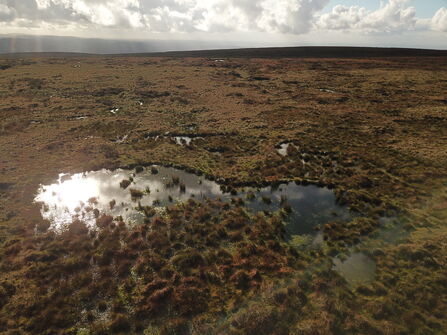
Bog pool vegetated with Sphagnum moss. Credit: Tom Aspinall / RSPB.

In this guest blog, RSPB Senior Policy Officer Tom Aspinall presents his views on the journey from fire risk to resilience for UK peatlands.

Bogs - wild, wet, wonderful

Picture a woodland; what image develops instantly in your mind’s eye? Trees I’ll bet, and lots of them! OK, let’s try another habitat, this time a bog; what does your mind conjure up now? Water, right? 

We all know that bogs are naturally wet, places you get “bogged down” in -  even the word bog stems from the Scottish Gaelic "bogach", meaning a marsh or soft, spongy ground. Soft because it’s wet. Doesn’t it seem strange then that here we are in the 21st century having to justify this long-established fact; that bogs should be wet and…boggy?

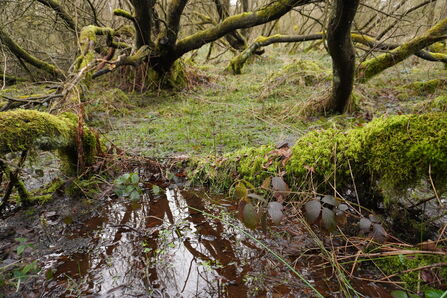
A peatland landscape with a large, vegetated bog pool and a Sphagnum hummock in the foreground.

A healthy bog in the UK should be home to an abundance of Sphagnum moss species. Credit: Tom Aspinall / RSPB.

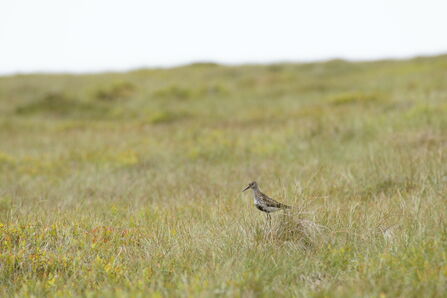
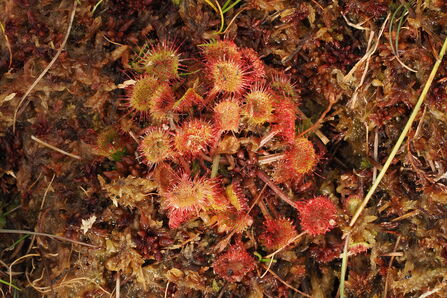
There are many reasons why it’s important that bogs should be wet: firstly, and always RSPB’s priority, for wildlife. Healthy bogs are a haven for some very specialised organisms. Take carnivorous plants like sundews - they have evolved to live in these seemingly hostile environments, able to extract nitrogen not from the soil, but from insects instead, a remarkable evolutionary trick. Then of course there’s the birds – Golden Plover, Dunlin, Curlew, and in the far north of the UK, Greenshank – wading birds, birds that need wetness to find their preferred, insect food.

Beyond the biodiversity benefits of a healthy bog are their other special attributes.  They slow water movement, therefore playing a role in reducing the risk of flooding downstream while maintaining a steady supply of water which we humans utilise extensively for our very survival. They absorb, trap and store carbon, helping to regulate the Earth’s climate, and they have a natural resilience to the increasing threat of human induced fires - the topic of our video below.

Fire – an unnatural process

The UK’s uplands have long had a problem with fires, but unlike fire adapted habitats such as Australian Eucalypt forests, or North American Pine forests, where many species actually rely on the natural occurrence of fire – from lightning strikes for example – these fires in the UK have been and still are almost exclusively started by people – whether intentionally or accidentally. Therein lies the problem.

When fire is introduced to a system at greater frequencies than it would naturally occur – as with rotational burning by grouse shooting interests in UK uplands – that system starts to suffer and deviates away from its natural state. Plants that haven’t evolved alongside regular fire events struggle to persist, burnt out of existence. And the medium they grow in suffers too. 

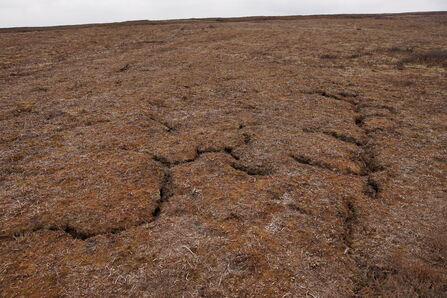
Bogs are peatlands, because what lies below the surface is peat, a soil type made up almost exclusively of undecayed organic matter – and peat only forms where it’s wet. On a functioning bog, in the presence of a naturally high water table, peat continues to form as the anaerobic conditions provided by the living layer of saturated Sphagnum mosses on the bog surface prevents the decay of organic matter. However, when a bog starts to dry, for example after repeated fires at unnaturally frequent intervals (often alongside drainage), peat formation stops and vegetation and peat start to decay, releasing stored carbon dioxide back into the atmosphere. The peat that was saturated and therefore protected from fire now also becomes a potential fuel, ready to burn at the next ignition.

Some plants too add to the problem of increasing fuel. Species that on a wet and healthy bog would only make up a small proportion of the vegetation begin to thrive in these new drier conditions, outcompeting those that require permanently waterlogged conditions. Two of those plants, Heather (Calluna vulgaris) and Purple Moor Grass (Molina caerulea) are now widespread and dominant, and they have something in common: they’re very, very flammable.

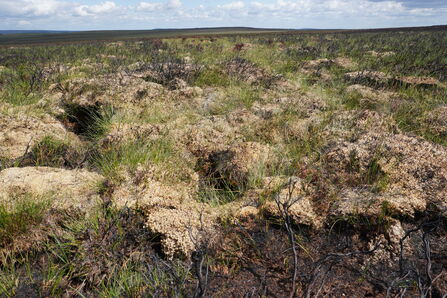
Bank of heather in an area subject to managed burning. The bank is next to a more recently burned area with some bare peat and shorter vegetation.

Burning encourages dominance of heather (Calluna vulgaris) at the expense of a more natural and less flammable vegetation community. Credit: Tom Aspinall / RSPB.

A burning problem

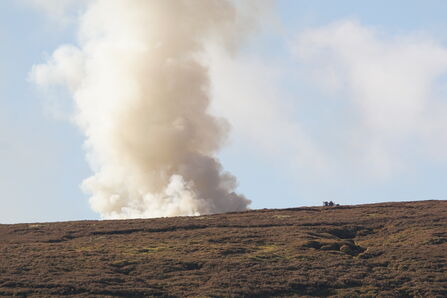
Burning has contributed to the dominance of these two species and that has left our degraded upland peatlands – those places that should be wet and boggy – increasingly vulnerable to future fires.  And while there are a range of causes of those fires, statistics have repeatedly shown that it is the intentional and ‘managed’ burns that are often responsible for some of the larger fires, when those burns get out of control. Interestingly, before cutting a fire break around a proposed burn became common, as documented by a former gamekeeper in ‘The Glorious Grouse: A Natural and Unnatural History’ by Brian P. Martin, burning all too often used to lead to “massive conflagrations” (and sadly it still too often does).

What has followed from this change in the fire regime on our bogs is a negative feedback loop; as fire dries bogs, further fires become more likely and the cycle of drying and increased flammable vegetation types and dry peat persists. It’s a cycle we must stop, and the only way to do that is with fire’s worst enemy, but a bogs best friend, water. We need to bring it back.

Restoration to resilience

And this leads us to the video we at the RSPB have just produced. We take fire very seriously and that is why we want to make our upland landscapes as resilient as possible, and on a bog that means making it wetter. We do not burn vegetation because burning has contributed to the fire prone state we now witness. Instead, we are doing everything in our power to restore water and the less flammable vegetation types that a healthy upland landscape should support, whether that’s Sphagnum moss on the bogs or native broadleaf woodland around the edges.

As we transition to these wetter, more naturalistic and naturally fire resistant landscapes there are short-term interventions that we continue to undertake, such as cutting strategically located firebreaks to break up uniform stands of potential fuel. In the long-term however, through a combination of actions, such as hydrological recovery and native woodland establishment, these interventions will be required less and less often in fewer and fewer places, but innovation is important too. There are restoration tools we now utilise that weren’t available to us in the not-so-distant past, and so we must continue to innovate, and create new tools that help us tackle the challenges we face today. 

This short video explains our approach, and that of our close partner, the National Trust. By acknowledging the problems and implementing the solutions, we can make a real difference. We can’t eradicate fires – ignitions by people are always likely to be an unfortunate reality – but by working alongside nature to restore the habitats and systems our actions have historically degraded, we can make fires less frequent, less severe and importantly for our Fire and Rescue Services and fellow upland managers, easier to put out when they happen.

IUCN UK Peatland Programme guest blogs represent the views of the individual(s) or organisation(s) who have authored the content.